Jesse Jackson Was The Last Black ‘Leader’
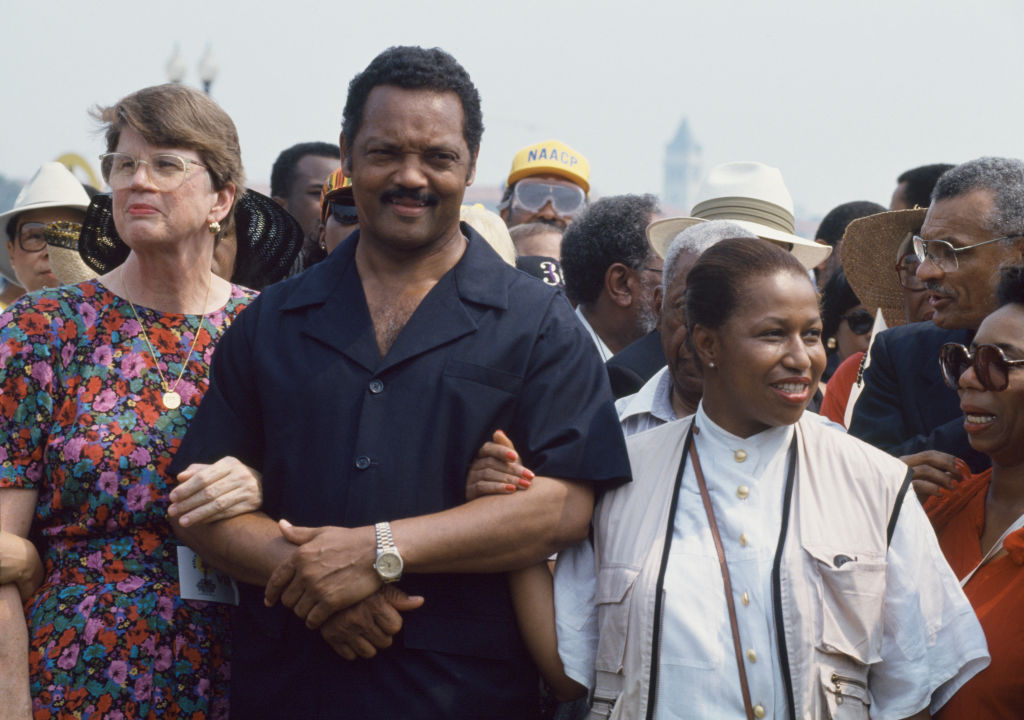
When the news broke that Jesse Jackson died, I did what we all do now.
I went online to observe the conversation.
What I found wasn’t unified grief or even unified respect. It was cacophonous. A timeline full of the hottest takes. Some reverent. Some dismissive. Some clinical. Some cruel. But it all boiled down to a whole lot of people with a whole lot of conflicting opinions about who Jesse Jackson was, what he wasn’t, and what we had projected onto him over the course of his public life.
But what became clear to me as I scrolled is that most of us weren’t even talking about the same man.
We were talking about whatever version of Jesse we met.
For our Boomer parents, he was a peer. A man who walked through the struggle alongside them. For Gen X, he was an established giant. Flawed, yes, but formidable. For many Millennials and Gen Z observers, he was a relic. A preacher/politician with a megaphone employing past era tactics who seemed more comfortable rhyming slogans than building something tangible.
The disconnect isn’t just generational.
It’s moral.
Because what I saw online wasn’t simply critique. It was judgment, filtered through a 2026 lens, imposed upon a man who rose to prominence in a very different era with completely different standards.
And that’s when it hit me:
Jesse Jackson may have been the last Black leader. Or, at least the last one we will ever be capable of collectively accepting.
Not because he was perfect.
But because we no longer share the kind of moral and cultural alignment that makes “collective leadership” possible.
Yes, Jesse had flaws. He had personal failings that clashed with his public presentation. His extramarital affair and the child that resulted from it complicated the image of a man, rooted in the pulpit, who often spoke in the language of moral uplift while challenging our community to do and be better.
That’s real.
But here’s the thing: he was a man of his era, and a man who defined an era.
He came of age during a time when Black leadership was forged in churches, community centers, and movement spaces. When moral authority wasn’t built on virality, but on visibility in the flesh and the sacrifices one was witnessed making. When you had to show up somewhere physically and speak to actual people, not just followers.
The old world gave leaders a measure of privacy. Not invisibility. Not immunity. But privacy. Enough space for a person to have contradictions without having their entire identity reduced to them.
Today, we live in a landscape of permanent exposure.
Every like is a statement. Every follow is an endorsement. Every old tweet or post is a landmine waiting to be unearthed.
How, exactly, are we supposed to fairly judge Jesse Jackson from a time like this, especially when our own moral lens is so skewed?
Because let’s be honest about something.
We live in an era that has normalized vice as a baseline, while simultaneously pretending to hold everyone else to impossible standards.
That’s what I saw when I watched people online dismiss Jesse as overly focused on respectability politics.
But those same critics listen to, or even host, weekly podcasts about “gettin’ this money” no matter the cost.
I saw folks moralize about his personal indiscretions.
Meanwhile, they’re probably subscribing to somebody’s OnlyFans for $3 a month, rationalizing it as “supporting creators.”
We want to drag him for having a child outside his marriage while quietly participating in digital economies built entirely on voyeurism and commodified intimacy.
We want to say all Jesse did was “talk.”
But we’re on social media every day, chasing attention, producing nothing of substance for the community we claim to love. Gum bumpin’, signifyin’, and perpetrain’ like our opinions carry some kind of weight or import outside of our limited sphere.
Let he who is without sin cast the first stone.
The difference between Jesse’s era and ours isn’t that he was cleaner and we’re dirtier.
It’s that he at least operated in a world where virtue was still the stated aspiration.
Now? Vice is not only tolerated; it’s monetized, incentivized, and branded as authenticity. Some might even ironically call it “self-care.”
So when we judge him, what standard are we using?
Ours?
Because if we’re using ours, we need to be honest about what that looks like.
Because here’s the larger issue.
Jesse Jackson rose to prominence at a time when Black America, while diverse in thought, was anchored by a few shared values forged by a common struggle.
The church mattered, not just religiously but also communally. Respectability—however contested—was a shield against stereotypical expectations and outcomes. Public comportment was part of leadership because those voices represented a voiceless constituency.
You didn’t have to agree with him to recognize him as a leader. His stature was a testament to his efficacy.
That’s the key distinction.
Today, we don’t have that kind of shared moral ground or communal struggle.
Our community is ideologically fractured. Politically splintered. Economically bifurcated. Digitally siloed.
There is no singular march. There’s no unifying sermon. There are only timelines and the feedback loop of likes and shares.
And timelines are designed to divide and engineered to enrage.
The algorithms reward critique over consensus. They elevate hot takes over careful thought. They platform whispers and unverified claims until they metastasize into perceived truth.
So imagine someone today attempting to ascend to the perch Jesse once occupied.
Before they could finish a sentence, someone would pull up old tweets from 2009. Someone else would dissect who they follow on Instagram. Someone would circulate rumors under the guise of “just asking questions.”
We don’t just scrutinize leaders now; we preemptively erode them.
The idea of a singular Black leader—someone who commands broad respect even among detractors—feels impossible.
Not because we don’t have talented people. Not because our struggles have abated. Not because we lack the need for unity.
But because we no longer have the social bandwidth to allow it.
You see, the old world had gatekeepers. That system was, admittedly, flawed. It protected some people who shouldn’t have been protected and excluded others who deserved a platform. We mainstreamed and marginalized according to a normative standard of the time that isn’t congruent with modern ideals.
But what it did do was create space for reverence.
You could disagree with Jesse Jackson and still feel the weight of his presence. The historical context. The sacrifices. The risk.
Now, exposure has replaced reverence.
Everything is flattened.
A man who ran viable presidential campaigns in the 1980s that planted seeds that sprouted into real power is discussed in the same dismissive tone as a random influencer with a ring light.
We treat decades of movement work like it’s just another content stream to be rated, reviewed, and reduced.
And in that flattening, something essential is lost.
Not blind loyalty.
But proportion.
Here’s the uncomfortable truth:
With the way we operate now, no one could ever reach Jesse Jackson’s perch again.
Not because there aren’t capable leaders, but because we, as Black people, would never allow it.
The moment someone begins to consolidate influence, the takedown begins. Sometimes the critique is warranted. Sometimes it’s petty. Often, it’s performative.
And even when the person survives the first wave, the erosion never abates.
There’s always another screenshot. Another clip taken out of context. Another whisper campaign. A self-fulfilling loop of put-downs, take-downs, and letdowns that eventually coalesce into a public weakening.
We’ve mistaken perpetual suspicion for sophistication.
But suspicion alone cannot build movements.
It can only dismantle them.
What makes this moment even more ironic is how flexible our own morals have become.
We excuse behaviors in ourselves and our peers that we would have condemned in prior generations. We celebrate hustle culture, even when it edges into exploitation. We normalize gambling as entertainment, voyeurism as empowerment, and clout-chasing as ambition.
Yet when we look back at Jesse Jackson, we want to apply a standard of purity that none of us are living by. But how?
That disconnect is glaring.
You can’t operate in a morally hazy ecosystem and then pretend you’re standing on solid ground when it’s time to judge someone else.
If anything, our current era makes it harder—not easier—to throw stones.
This isn’t about canonizing Jesse Jackson or dismissing his idiosyncrasies as a man.
It’s about recognizing that he may have been the last of a certain kind of Black leader.
The last one to emerge from a shared cultural foundation strong enough to sustain both admiration and critique without total collapse.
He was controversial at times, yes. But his controversies existed within a framework where his contributions were understood.
We may never have that again.
Not in a world where every leader is simultaneously a brand, a content creator, and a potential liability. And definitely not in a world where we are more committed to deconstruction than construction.
Maybe the most honest thing we can do in the wake of Jesse Jackson’s passing is not to litigate his flaws, but to own our own context.
We are not living in a morally superior time. We are living in an exposed one.
We are not more discerning. We are more fragmented.
We are not more principled. We are more performative.
That doesn’t make us evil.
But it does make it nearly impossible to produce the kind of unified leadership that defined previous eras.
Jesse Jackson was imperfect.
He was human. He was ambitious. He was flawed.
And he still managed to occupy a space that commanded broad acknowledgment.
That space is gone.
And until we recover some shared values—or at least some shared humility—we won’t see it again.
Not because we don’t have potential leaders.
But because we don’t have the moral foundation or the collective patience to let one rise.
And that may be the real legacy his passing leaves us to wrestle with.
Corey Richardson is originally from Newport News, Va., and currently lives in Chicago, Ill. Ad guy by trade, Dad guy in life, and grilled meat enthusiast, Corey spends his time crafting words, cheering on beleaguered Washington DC sports franchises, and yelling obscenities at himself on golf courses. As the founder of The Instigation Department, you can follow him on Substack to keep up with his work.
SEE ALSO:
Civil Rights Leader Jesse Jackson Dies At 84
Le[e]gal Brief: Rev. Jesse Jackson Showed Us We Were Somebody
Perspective: Without Jesse Jackson, There Is No Barack Obama
What Reverend Jesse Jackson Means To Me And The Still Unfinished Movement