Caitlin Clark Lost Her Footing, So Her Fans Called 911
When my eldest godson Amari was a toddler and learning to walk, he tripped and fell often. Because he was the first child I had ever babysat solo, every tumble sent me into a mini spiral.
My instinct was to execute what best can be described as a frantic rescue mission. I’d drop whatever I was doing and rush over to him, scoop him up, and anxiously ask him if he was ok while my mind was already mapping out the quickest route to the nearest emergency room.
Before long, this became our pattern. He would fall, immediately look up to scan my face as he started to whimper, and then begin screaming bloody murder based entirely on the terror reflected in my eyes.
One afternoon, our alarmist routine unfolded in front of his family, leaving them thoroughly bewildered by his extreme reaction and my over-the-top panic. At that moment, they didn’t recognize either one of us.
Fortunately for both of us, a family member offered me a pivotal piece of insight, pointing out gently that I was teaching him how to react before he had an opportunity to check in with himself and evaluate his physical reality. His tears had become a mirror of my panic.
The next time it was just the two of us, I tested the advice. When he took an inevitable spill, I forced myself to remain stationary. I sat back, watched calmly out of the corner of my eye, and gently told him to get back up. He had still looked at me to gauge my expression and response, but when he saw calm instead of full on panic, he learned to brush himself off and keep walking.
Indiana Fever guard Caitlin Clark has become that toddler, and her blindingly loyal fans have become the over-anxious, hyper-reactive babysitters.
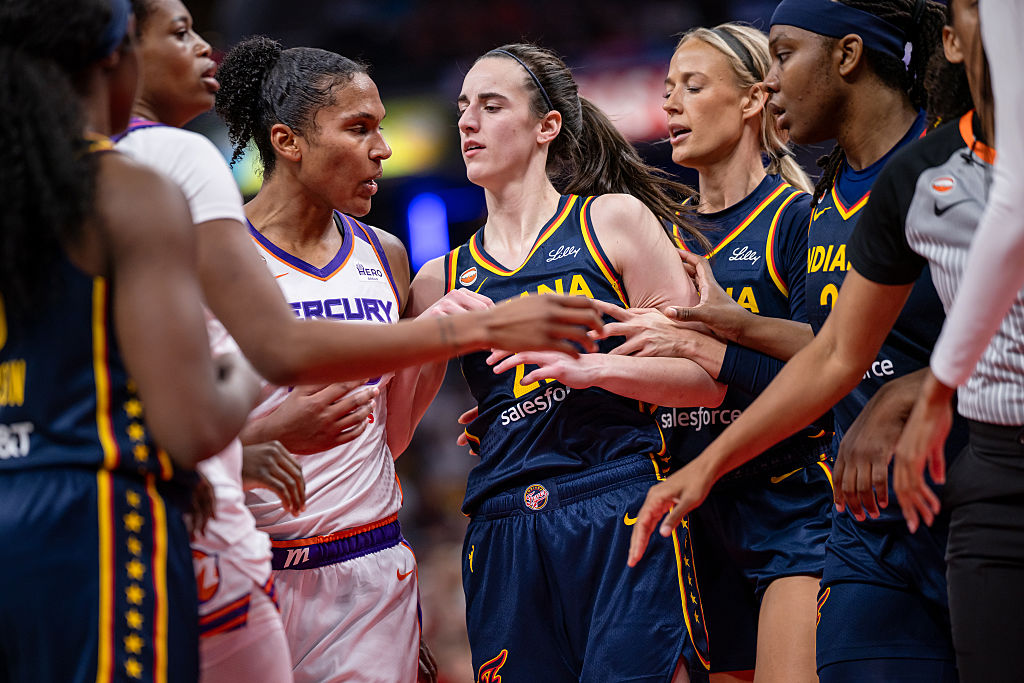
If you have spent any time on social media in the past day or so, you have undoubtedly witnessed the flashpoint everyone is talking about. A second-quarter play involving Phoenix Mercury star Alyssa Thomas and Caitlin Clark has gone viral and raised questions about whether the refs should have intervened.
I will get back to that specific controversy in a moment.
First, I want to look at a play in the opening quarter. Clark went up for a three-pointer, took a mid-air foul, and landed awkwardly. As her ankle appeared to roll slightly upon landing, I grimaced watching from my living room, thinking she had been injured. It felt like the refs blew their whistles before she landed. She recovered immediately, staying on her feet through the contact and bouncing right back with a pep in her step. When it happens, an instantaneous whistle from the officials seems to trigger a Pavlovian response in Clark, functioning as a physical green light that no theatrics are needed.
If she hadn’t heard that whistle, I’m not confident that based on past behavior, she would have bounced back. History (and lots of tape) indicates the likelier scenario would have included her cascading onto the floor with more force than had been inflicted upon her.
In fact, she has been thrown off by a lot less. The most extreme example happened during a preseason game this year when her own ponytail whipped her across the face. Despite the defender’s hands being nowhere near her, her head snapped back as if caught in a gale-force wind, as she recoiled as if she’d been attacked by her defender.
Another incident unfolded later in the Mercury/Fever matchup. Clark went up for a shot, flopped heavily in front of her defender, landing in a heap on the floor. This time, she stayed down, grimacing and clutching her back. She stayed in the game and played all of the second quarter and most of the third before citing back pain that required her to exit.


Neither of these plays from the most recent game has garnered as much attention on social media because neither fits into the longtime narrative she’s created that her fans have bought into.
Clark has established a well-earned reputation as a flopper who routinely exaggerates even minor physical contact to manipulate officials, and who has learned that physical confrontations, instigated or amplified, are equally useful for getting the crowd and her fans watching from home worked up.
In a previous matchup between the two teams earlier this week, when Sophie Cunningham and DeWanna Bonner stood pointing at one another with teammates pulling them apart, Clark turned away from the standoff and raised an arm toward the upper deck, urging the crowd louder, conducting the noise as if she wanted to see the fire she started spread.
Now let’s talk about what has become the main event. Clark lost her footing, and as she went down, a chaotic scramble for the ball ensued, and Thomas collapsed over her. Thomas’ fist appeared to roll down Clark’s arm and landed on her neck.
There was no punching motion or indication of ill intentions. When Thomas got up, she stepped around Clark cleanly and headed straight down the court without a word, celebration, or even as much as a backward glance.
A video clip of the interaction went viral immediately, picking up massive steam during halftime as Clark’s fans loudly demanded Thomas be suspended or even arrested for battery. Fans who have circulated freeze frames of Thomas’ fist on Clark’s neck are pulling a single image out of a sequence that tells a very different story.
Yet, if you watched the full game, you saw a different reality. There was no physical response from Clark that indicated Thomas caused her serious injury. Her teammates and Clark herself, who just days prior had fiercely gone after the same team during a highly contentious matchup, didn’t react strongly.
Clark herself looked disappointed by the no-call, but her usual outsized response was absent. Nobody on the floor panicked because nobody gave her the panic to mirror until the videos started circulating.
Zeroing in on a single frozen moment, without the benefit of what came before or after it, has distorted the public’s understanding of major events before.
Howard Dean was the Democratic presidential frontrunner, widely expected to win the nomination, until he yelled into a microphone at his Iowa caucus rally. Overnight, the press recast him as erratic and unelectable and questioned whether he had a bad temper.
What the coverage didn’t reflect was that the microphone was unidirectional, filtering out the roaring crowd in such a way that amplified his voice.
It is hard not to wonder whether, had iPhone cameras been as ubiquitous and capable of capturing vivid video and pristine audio as they are today, attendees would have flooded social media with their own angles. If so, the scream might never have derailed him as a candidate.
The viral clip from the game is the contemporary sports equivalent of that. It isolated and stripped away all the context of the live game and fed a hungry fan base eager to become enraged by any perceived transgression the panic they have been primed to mirror.
Fever head coach Stephanie White, who appeared calm on the sideline when the play happened during the game, showed up to the post-game press conference enraged. She demanded the league step up to protect her “generational talent” and “WNBA superstar”, ignoring the irony that her own players, including Clark, regularly instigate physical altercations, throw elbows, and go after opponents on the court.
As the old adage goes, the squeaky wheel gets the oil, especially when the wheel has been propped up as the league’s golden child. The WNBA suspended Thomas for one game, a decision that rewards the noise without fixing the larger issue.
My hope is that the league hears the social media uproar and acts with objective sobriety regarding the larger picture. A good place to start would be with the physical toll endured by Atlanta Dream star Angel Reese and other players who are regularly on the receiving end of unduly rough physical play that officials don’t call.
The WNBA would do well to establish an independent replay center modeled after the MNBA’s, to strip the emotion out of officiating decisions before viral moments take over.
Until then, women’s basketball will remain trapped in this concocted spiral of outrage that has taken on a life of its own. For its part, the league needs to hold referees accountable for getting these calls right across the board, every game, for every player.
And Clark’s fans and the league office need to develop a thicker skin and stop mapping out routes to the emergency room every time their golden child takes a spill on the basketball court.
SEE ALSO:
Angel Reese, Izzy Harrison, And A League That Won’t Protect Its Stars
The Unraveling: How Reality Caught Up With The Cult Of Caitlin Clark


