Last In Line: A Pride Month Reflection On Being Black, LGBTQ
Last In Line: A Pride Month Reflection On Being Black And LGBTQ
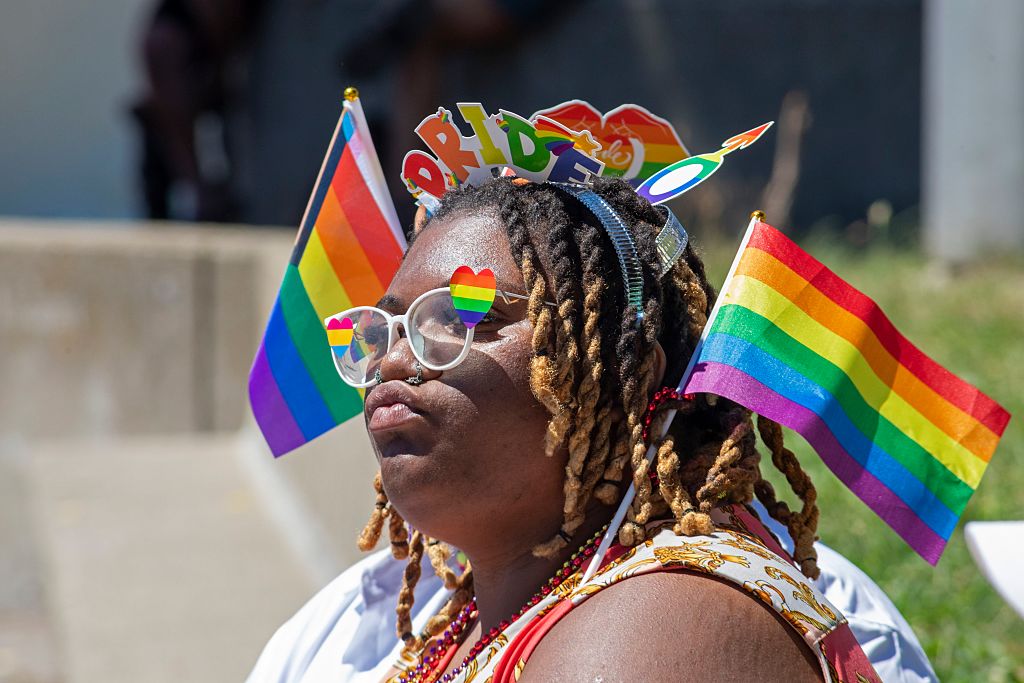
Every June, Pride Month arrives with parades and rainbows to celebrate what it means to be a member of the LGBTQ community. It’s supposed to be the one month of the year when LGBTQ history and issues are front and center.
For Black LGBTQ people, the month and its celebrations sting a little. White voices and priorities often dominate Pride. Having parts of ourselves left out is something we also experience within the Black community.
In that version, we have often been maligned or told to leave our LGBTQ identities at the door and out of the conversation when it comes to prioritizing what rights and freedoms the Black community fights for first.
No matter which of these rooms we walk into, the rights that address our full lives, as Black and LGBTQ, never make it to the top of either agenda. Instead, we end up last in line.
Bayard Rustin was the genius behind the 1963 March on Washington, who built one of the largest demonstrations in American history, engineering the logistics to transport, feed, and organize over 250,000 participants in less than two months. Instead of being held up and celebrated, he spent his career maligned because he was gay.
Days before the March, segregationist Strom Thurmond took to the Senate floor to launch a vicious attack, calling Rustin a pervert and reading his 1953 arrest for same sex intimacy directly into the Congressional Record in a desperate bid to discredit Rustin and dismantle the entire movement.
Pauli Murray was the legal genius who framed the overarching legal strategy for Brown v. Board of Education, providing the blueprint that Thurgood Marshall’s team used to dismantle segregation. Marshall famously revered her work as “the bible” of the civil rights movement. Yet Murray privately wrestled with a gender identity that the mid-century lacked the language or tolerance to accommodate. Ultimately, that societal blindness and bigotry relegated her to the periphery of a movement her brilliance helped fuel.
This inescapable fracture for Black LGBTQ folks is often deeply rooted in the historical sanctuary of Black life: the church. While the Black church has often been the central institution combatting systemic racism, it has historically remained one of the most resistant to accepting queerness.
According to the Pew Research Center, 7 in 10 Black Americans viewed homosexuality as a sin, while only one in eight Black pastors saw nothing wrong with same-sex marriage. Black LGBTQ people are expected to show up fully for the collective Black struggle while keeping whole parts of ourselves, in this case our sexuality and romantic partners, completely out of sight.
The implicit message has consistently been that issues related to our queerness belong somewhere else, that we should take them to the broader LGBT community to be addressed, and keep the Black agenda focused on race. A 2024 HRC study found that 80.9% of Black LGBTQ youth have experienced homophobia or transphobia within the Black community and 74% have experienced racism in the LGBTQ community.
Another study found that 60% of Black respondents said they believed that advances for the LGBTQ community had come at the expense of Black civil rights, which shows that our queerness is often seen as a competing interest rather than an integral part of who we are that is deserving of advocacy, attention, and protection.
This silence accumulated a devastating body count during the AIDS crisis, when Black gay men were dying at catastrophic rates among communities that were quick to turn the other cheek. AIDS has disproportionately devastated Black Americans, who contract HIV at higher rates and die faster than any other racial or ethnic group.


Black gay men in the South continue to die of AIDS that, for white gay men with the healthcare access and economic resources to afford life-saving antiretroviral medication, long ceased being a death sentence and became a manageable condition.
The segment of the LGBTQ community setting the agenda has never had to fight on two fronts just to be seen as fully human. This agenda has always been driven by white gay men who benefit from the luxury of defining it.
Because white gay men occupy nearly every position of structural and economic advantage with the exception of their sexuality, the priorities of the LGBTQ movement they have a heavy hand in shaping reflect that reality. For them, sexuality is often the single obstacle standing between them and full privilege in American life.
Scholar Lisa Duggin coined the term “homonormativity” in 2002 to describe this framework. Similarly, Allan Berube documented how gay identity in America has historically been constructed as white identity, a process requiring the systematic erasure of LGBTQ people of color from the movement’s image, leadership, priorities, and memory.
For years, that erasure materialized most visibly in gay commercial nightlife, where Black patrons were turned away at the door or forced to produce multiple forms of identification while white patrons walked in freely.
When Black folks did make it inside, we were often met with signs reading, “No Blacks, Fems, or F—–s.” Sadly, this blatant exclusion is not a relic of the distant past. It was documented as early as 1986, and a 2017 city Commission on Human Rights study found that by and large, gay bars remained focused on catering to white, cisgender male patrons. Shut out from these spaces, Black queer people have built our own bars, curated our own events, and created a parallel world where we are embraced rather than excluded.
White women in the LGBT community occupy a related and distinct position: outside of gender, sexual orientation is often the primary, and in some cases, the only significant site of discrimination in their lives.
In fact, research shows that lesbian women earn an average of 9% more than straight women. Economists attribute this wage premium to higher education levels, greater labor force participation, and often the absence of systemic parenting and domestic labor penalties that routinely depress straight women’s earnings and career growth.
Despite this economic buffer, white lesbians have long insisted that their experiences with homophobia are equivalent or surpass the racism Black people encounter. The earnings and other data make their posture difficult to sustain.
This misalignment of priorities is evident in studies conducted of youth across racial groups. A 2014 nationally representative survey from the Black Youth Project found that while white youth ranked marriage equality as the top priority, Black and Latino young people named HIV/AIDS, employment discrimination, bullying, and violence.
Economic justice and survival often top the agenda for Black LGBTQ people for the exact same reason that issues like environmental justice, while universally important, register as a baseline priority for white liberals yet rarely command immediate urgency for many Black people.
The reasons are clear: it is difficult to get worked up about the carbon footprint of plastic grocery bags when you don’t have enough money to afford the groceries to put in them.
If you are forced to choose between paying the rent, keeping your lights on, or facing a glass ceiling at work due to ongoing discrimination, the movement to ban gas stoves feels like a fight that might as well be happening on another planet.
For Black LGBTQ people, marriage equality was the grocery bag of the LGBTQ movement, a boutique issue that mattered most to those who had the luxury to care about it in isolation.
Black Trans Americans experience the brunt of this neglect far more than any other segment of the LGBTQ community, enduring a reality whose bleak metrics should have made them the movement’s obvious priority.
Thirty-eight percent of Black Trans individuals live in poverty, and 20% are unemployed, which is nearly twice the rate of Black Americans overall. Furthermore, nearly a third have been unhoused at some point in their lives.
Meanwhile, gay men earn roughly 10% more than their straight counterparts, and Census data illustrates married same-sex male couples reporting a median household income of approximately $142,000, the highest of any couple demographic in the country. Legal scholar Darren Lenard Hutchinson characterized this stark material divide as a deeply compromised, narrow vision of “Gay rights for gay whites.”
Hutchinson’s critique exposing “Gay rights for gay whites” targets the systemic blind spot that legal scholar Kimberlé Crenshaw codified in 1989 under the expansive framework of intersectionality. Crenshaw posited that when multiple marginalized identities overlap, they multiply, creating distinct, compounded forms of exclusion that single-issue advocacy doesn’t account for and cannot solve.
Long before the academy formalized this concept, Black lesbian poet and activist Audre Lorde illuminated the danger of fracturing these struggles and being forced to fall into line with single-axis movements.
In her foundational essay, There is No Hierarchy of Oppressions, Lorde argued that ranking human suffering or isolating political fights only serves to dismantle the collective power required for true liberation.
She instinctively understood that a victory for one faction of a movement is hollow if it stands atop the systematic abandonment of another.
Lorde masterfully observed: “…among those of us who share the goals of liberation and a workable future for our children, there can be no hierarchies of oppression. I have learned that sexism and heterosexism both arise from the same source as racism.”
Decades later, data proves that liberation cannot be delivered through marriage certificates and true freedom cannot be achieved through racial justice strategies that demand Black LGBTQ folks be closeted. When movements force a choice between identities and/or an allegiance to one, they fracture people.
Pride Month lasts 30 days. The experience of being Black and LGBTQ in America lasts our whole lives. Both the Black and LGBTQ communities have benefited from our labor, our organizing, and our silence. It’s time those communities invest in our whole lives, and with the same urgency that the deprivation of our rights deserves. We are tired of being last in line when our vulnerability suggests we should be among the first.
SEE ALSO:
Pride Is Still Protest: World Pride in the Era of Trump 2.0
Corporate Sponsors Have Us Asking: Where’s The Pride?


