Wardell Milan On How Black Artists Challenge America's Story
How Black Artists Challenge America’s Story | Life, Liberty And The Pursuit Of Happiness
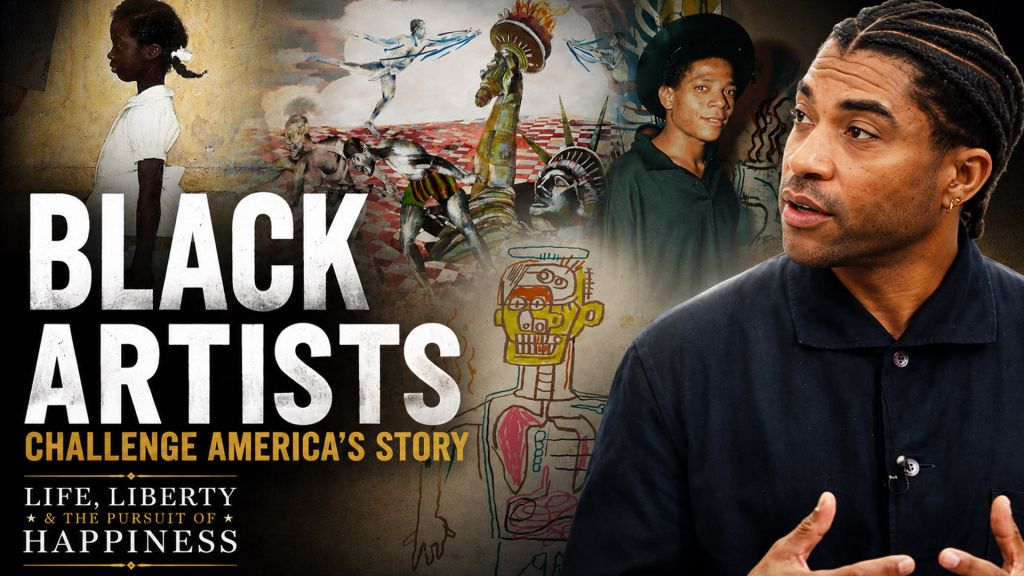
On the latest episode of NewsOne’s Life, Liberty and the Pursuit of Happiness, visual artist Wardell Milan explores the ways generations of Black artists, and some of their allies, have used creativity to document history, challenge perceptions and define themselves. Milan’s own multidisciplinary practice continues that tradition.
Working across photography, drawing, painting and collage, Milan often examines the tension between marginalization and freedom of expression, imagining spaces where marginalized bodies can move through the world freely and express themselves without constraint.
Wardell Milan believes artists can use creativity to empower, educate and document.
Milan believes artists possess a unique power to preserve history while using their work to empower people and bring difficult moments of the past into focus. He pointed to Norman Rockwell’s powerful painting of Ruby Bridges, “The Problem We All Live With,” which depicts Bridges being escorted by two U.S. marshals as she entered William Frantz Elementary School in New Orleans in 1960. Bridges became the first Black child to integrate the all-white school.
“Looking at the painting of Ruby Bridges and thinking about that history of desegregating Black and brown bodies, I’m reminded of that history and reminded of the great struggle that my ancestors went through to receive equality,” Milan explained. “How is she comprehending the task that she’s been asked to do? What is she thinking about when she is entering this space? And then beyond that, what’s the trauma that she’s experiencing after making this courageous, act?”
For Milan, documenting the present is just as important as preserving the past.
“I think it’s important for artists to capture what’s happening in the contemporary, what’s happening now, to be reflectors,” Milan added.
We saw it with the Harlem Renaissance.
Long before Rockwell, Black intellectuals and artists were developing new ways to define Black identity and challenge racist stereotypes. Alain Locke, the African American writer and philosopher, helped usher in this transformation through his landmark 1925 anthology The New Negro, a foundational work that launched the Harlem Renaissance. The movement represented a shift from simply enduring racism toward self-determination, racial pride and bold artistic expression.
Milan says the artists of the Harlem Renaissance demonstrated the importance of claiming agency and telling authentic stories.
“During that time, the visual artists, literary artists, musicians, there weren’t so much redefining what the Negro was during that time,” he explained. “What the Harlem Renaissance allowed was agency, because before this movement, there was very little agency for Black and Brown people to be expressive, to be intellectual, to be creative in a very courageous and unapologetic way. There’s a lot of legs in the air, jazz hands, and I think it’s just a great representation of how, even during the most difficult of times, even during the most financially challenging, emotionally stressful times, there’s still joy. There’s still much to be thankful for and much to celebrate,” Milan noted.
Wardell Milan’s exhibition More Action! More Excitement! More Everything! AMERIKA shows Black life and the human form as a site of vulnerability, resistance and transformation.
Milan continues to carry that spirit into his own work. Earlier this year, his exhibition More Action! More Excitement! More Everything! AMERIKA! was on view at Sikkema Malloy Jenkins gallery in New York City from March 27 through May 2.
Building on a conceptual foundation in photography, Milan’s multimedia practice explores the dualities of desire and violence, fantasy and history, and marginalization and freedom. By recombining photographic elements with paint, graphite and oil pastel, he presents the human form as a site of vulnerability, resistance and transformation.
More Action!… is part of an ongoing body of work examining the increasingly disorienting landscape of contemporary American society. Moving between personal experience and broader social realities, Milan captures the present as a constant negotiation between emotional and societal extremes.
“There’s a number of pieces that that are really being critical about the times that we’re living in, and one piece titled “America Number 23,” shows these two figures, these two men pulling the Statue of Liberty out of a sinkhole, and I think that’s an example of how I want to make work that is really in conversation with how we’re feeling about our country, about the world right now, how at least for some of us, it feels as if these tenets, these pillars, that we trusted and thought that it was firmly built upon, how these pillars seem to be cracking, are being dissolved,” he explained.
Another work Milan discusses confronts the history of slavery, servitude and the exploitation of Black women’s bodies. The earlier piece depicts a Black woman as a dominatrix, with a man wearing a Ku Klux Klan hood kneeling at her feet while she breastfeeds.
Milan explained that the piece represents the “history of servitude, the history of Black female bodies being used as not only property but as instruments of service for the power structure.” He added, “In this drawing, that power structure is flipped. It is the Black woman who is in control, and she has the power to deny or to accept. And it is the man in that clan’s hat who must be submissive.”
Watch the full episode of Life, Liberty and the Pursuit of Happiness with Wardell Milan above.
SEE MORE:
What Ruby Bridges Taught Us: The Lesson America Still Hasn’t Learned


