Postal Service Rule Overhauling Mail-In Voting Blocked Again
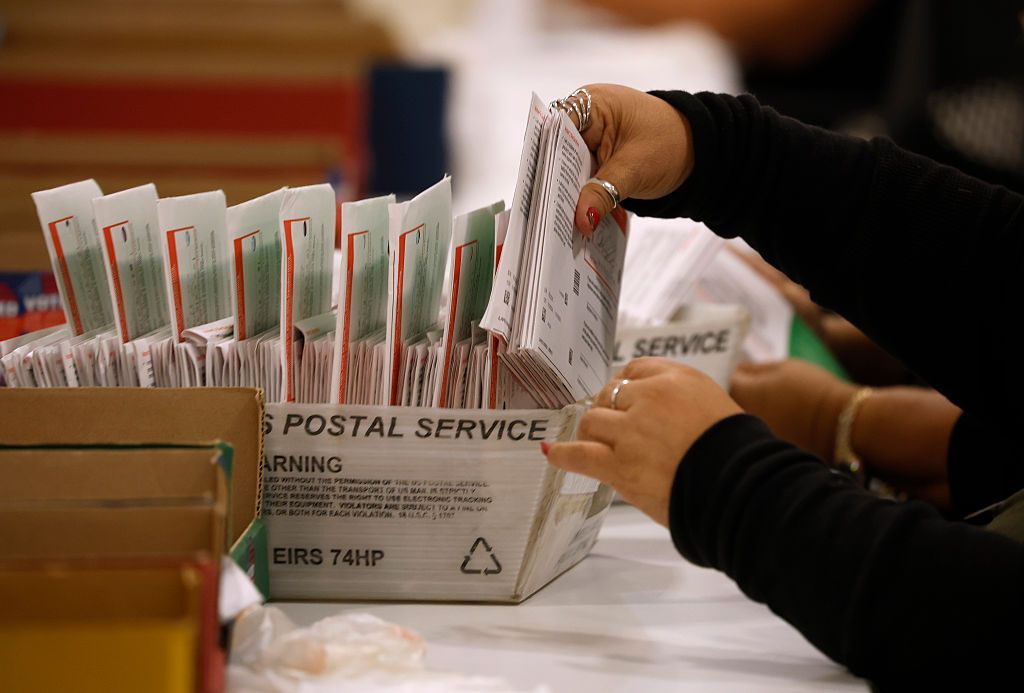
The Trump administration’s ongoing crusade to restrict mail-in voting hit another roadblock on Thursday after a federal judge blocked a rule implemented by the United States Postal Service (USPS) that would have drastically overhauled mail-in voting requirements.
Earlier this week, the Supreme Court struck down Judge Indira Talwani’s earlier block on the rule, deciding that the states filed their lawsuit too early. The court notably didn’t decide on the rule’s legality. AP reports that Talwani has issued a new block on the rule in response to a lawsuit filed by a coalition of attorneys general from Democratic states.
Last week, the USPS officially unveiled the new rule in response to an executive order issued by Trump earlier this year that aims to implement several restrictions on mail-in voting. The rule requires states to change the design of mail-in ballots and submit a list of people registered to receive mail-in ballots to an online portal. If states don’t submit their voter rolls to the online portal, the Postal Service will refuse to deliver mail-in ballots.
Which is crazy, because I don’t ever remember the post office being able to decide whose vote does and doesn’t get counted.
Talwani cited the short notice given to the states to implement the rule as grounds for blocking it.
“Plaintiff states have neither time nor funds to design new mail ballots, seek approval of the new designs, order production of mail ballots, update their own election management systems, train election officials to use the USPS portal and upload citizen data to the portal, all before the midterms,” Talwani wrote in her ruling on Thursday.
While the Trump administration has argued that the new rule is designed to protect “election integrity,” there’s been no evidence that mail-in ballots have led to widespread voter fraud. Nearly one-third of Americans vote by mail, so this new rule could significantly depress voter turnout in the midterms if implemented.
“This rule is a clear attempt by the federal government to interfere in elections it has no power to control. Today, a federal court halted it before this administration could wreak havoc on our elections,” New York Attorney General Letitia James, one of two dozen Democratic attorneys general who filed one of the suits, said in a statement after the order.
The Trump administration will undoubtedly appeal the ruling, which will likely lead to the Supreme Court ruling on the legality of the executive order. I’m very curious to see how far the court will go to capitulate to Trump. The Constitution explicitly places control of elections with the states, and in some instances, Congress. The Supreme Court’s conservative majority has loudly touted its “originalist” bona fides, and I’d be hard-pressed to find any interpretation of the Constitution that justifies the post office being able to disenfranchise a wide swath of voters.
Additionally, the Supreme Court struck down a circuit court ruling in Texas that found the state’s redistricting effort was racially gerrymandered. The primary factor in their decision was that the ruling occurred too close to the primaries.
Mind you, the ruling came five months before the state conducted its primary elections. So if a court can’t rule against maps for being racist nearly half a year before a primary, completely overhauling mail-in voting requirements just over two months before a general election should be a nonstarter.
Emphasis on should be.
SEE ALSO:
Coalition Of Democratic States Sue Over Trump’s Mail-In Voting EO
New Postal Service Rule Would Withhold Mail-In Ballots


