Why It Hits Different That Gen Z HBCU Students Are Crocheting
Why Gen Z College Students Are Crocheting, And Why It Hits Different At An HBCU
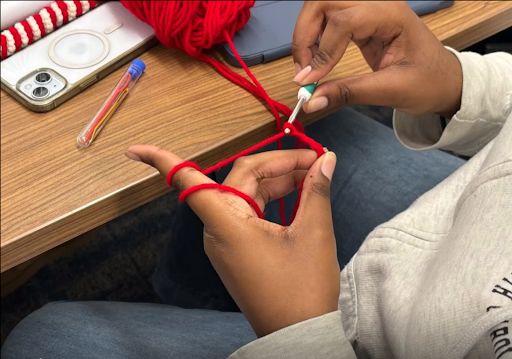
On a weekday evening at Howard University, a group of students gathers not to rehearse, organize, campaign, or network, but to sit, talk, and crochet. As yarn loops through hooks, conversations drift. The pace is slow by design.
In The Loop HU is a student crocheting club founded by Jala Wallace and Milan Zeigler during their sophomore year in 2023. Wallace reached out to Zeigler after discovering they shared an interest in crochet, and what began informally has since become an official student organization on campus. While the club centers crochet rather than knitting, a distinction Zeigler is quick to explain, the real work happening in the room goes beyond technique.
“Crochet uses a single hook,” Zeigler said. “You’re wrapping the yarn around the hook and looping it through. Knitting uses two needles, and the patterns come out differently.”
The explanation is practical, but the ethos of the club is even simpler. Everyone is welcome, and experience doesn’t matter. Some members have been crocheting since childhood, and others picked up a hook for the first time just weeks ago. The club provides tools and materials for those who don’t have their own. The idea is that participation, not expertise, is the point.
That accessibility is central to In The Loop’s appeal. Meetings are designed to feel open, low-pressure, and communal. Students come after long days of classes, jobs, homework, and responsibilities that demand constant productivity. Here, they are allowed to sit still and make something with their hands. They talk. They listen. Sometimes they’re quiet together.
At an HBCU, that matters.
Student life at Howard, and at many HBCUs, has long emphasized leadership, excellence, activism, and professional readiness. Student organizations often double as pipelines to careers, causes, and visibility. In that context, a crocheting circle quietly disrupts expectations. It is not résumé-coded. It does not perform urgency, and it values slowness in a culture that rarely affords Black women rest.
In The Loop also reflects a broader shift happening among Gen Z college students nationwide. Over the past several years, young people have gravitated toward nervous-system regulation and resistance to grind culture through analog, tactile practices such as crocheting, knitting, embroidery, journaling, and photography, as a counterweight to digital saturation and chronic uncertainty. This generation came of age amid a pandemic, political instability, climate anxiety, and economic precarity, all while living inside screens that never turn off.
Fiber arts offer something different because they demand repetition, focus, and patience. Neurologically, that kind of movement can be regulating and provides a sense of completion and control in a world that often feels unfinished.
Crochet, in particular, has taken hold because of its flexibility. With one hook and a skein of yarn, beginners can improvise, undo mistakes, and keep going without starting over. That openness mirrors how many Gen Z students approach learning and identity in a very non-linear, collaborative, and forgiving way.
But at Howard, the meaning deepens. Black women have historically been denied leisure that is not productive or monetizable. Craft has often been framed as domestic labor or hustle, as something to sell, optimize, or brand. In The Loop rejects that framing. Members are not crocheting to build businesses or social media platforms. They are crocheting just to be together. To decompress. To reclaim softness and repetition in a campus environment, and a country that frequently demands resilience without rest. The crochet is the vehicle, not the destination.
Similar crochet and knitting groups have quietly taken root on campuses across the country, particularly at predominantly white institutions, where they are often framed as wellness or hobby spaces rather than cultural interventions.
Universities such as the University of Delaware, Baylor University, George Washington University, and New York University host knitting or crochet circles that emphasize stress relief, creativity, and social connection. Harvard, Boston University, the University of Maryland, and Columbia host knitting and crochet groups where students gather weekly to create items together or donate them to charity projects. Students at these schools often describe the clubs as places to unplug from screens, manage academic pressure, and build community through repetitive, tactile work. While the structures vary, some meet informally, others partner with wellness centers or civic engagement programs; the common thread is a turn toward “slow crafting” as a response to burnout and digital overload among Gen Z students.
At an HBCU in Washington, D.C., a city defined by pressure, politics, and performance, a room full of Black women choosing slowness feels different.
What emerges from In The Loop is not just scarves, hats, or festive pieces, but connection. There is something quietly powerful about watching students come together over a practice that defies assumptions about age, background, and ambition. In a time marked by instability and acceleration, In The Loop offers a reminder that community does not always have to be loud or efficient to be meaningful. Sometimes it looks like yarn passing through patient hands, one loop at a time.
Lyric Swift is a junior journalism major at Howard University. She is interested in sports reporting. You can follow her on Instagram at @lyric.swiftt
SEE ALSO:
Burst Pipe Leads To Howard University Dining Hall Shutdown
DC’s New Initiatives Address Longstanding Health Disparities


