Thousands Rally After SCOTUS Cuts Black Voting Rights
Same Bridge New Fight: Thousands Rally After SCOTUS Cuts Black Voting Rights
- Rally at Alabama capitol honors civil rights history, vows to fight for fair maps and Black political power.
- Republican-led states move to redraw voting districts in ways that dilute Black voting strength.
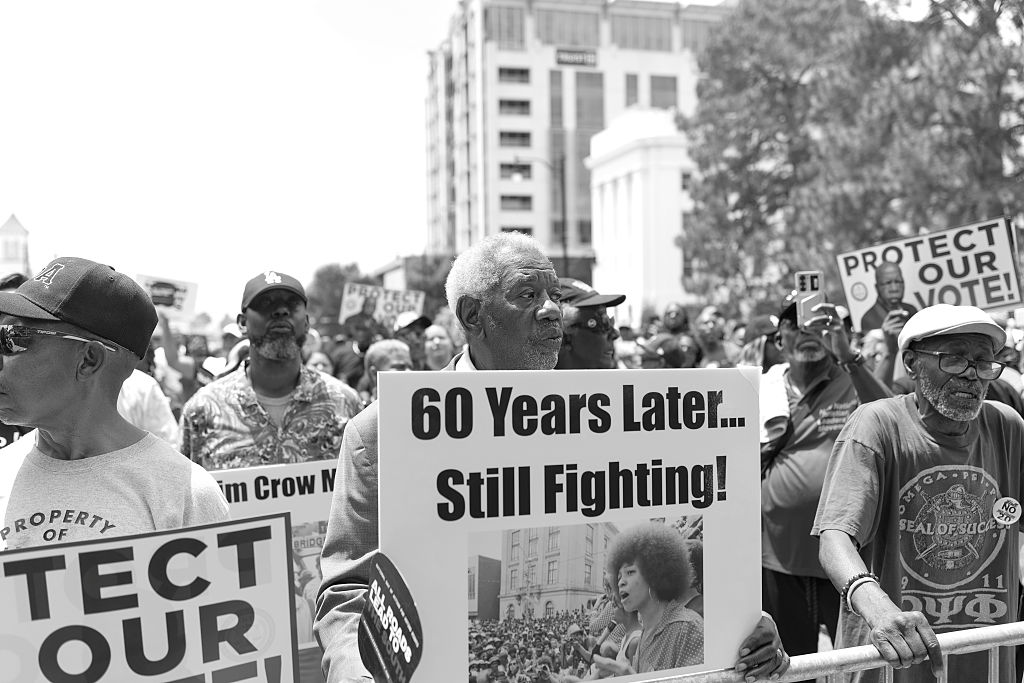
On May 16, thousands of Black voters gathered in Montgomery, Ala., for the All Roads Lead to the South rally, a powerful demonstration focused on protecting Black voting power in the aftermath of the Supreme Court’s controversial decision in Louisiana v. Callais, according to The Guardian. Photos taken by photographer Jason Davis captured rally-goers holding signs that read “fight for fair maps” and “60 years later still fighting” as they contested the Supreme Court’s latest decision.
In late April, the court issued a 6–3 ruling in the case, dramatically reshaping how racial discrimination claims under Section 2 of the 1965 Voting Rights Act are handled. Previously, plaintiffs only had to prove that voting maps had a discriminatory effect on minority voters. But under the new ruling, challengers must now prove lawmakers intentionally discriminated when drawing district lines for Louisiana’s Congressional map, a far higher legal standard.
For decades, Section 2 of the Voting Rights Act prevented states from creating maps that diluted the voting strength of Black and minority communities. Civil rights advocates say the ruling weakens one of the last major protections against racial gerrymandering.
What happened at the All Roads Lead to the South rally?
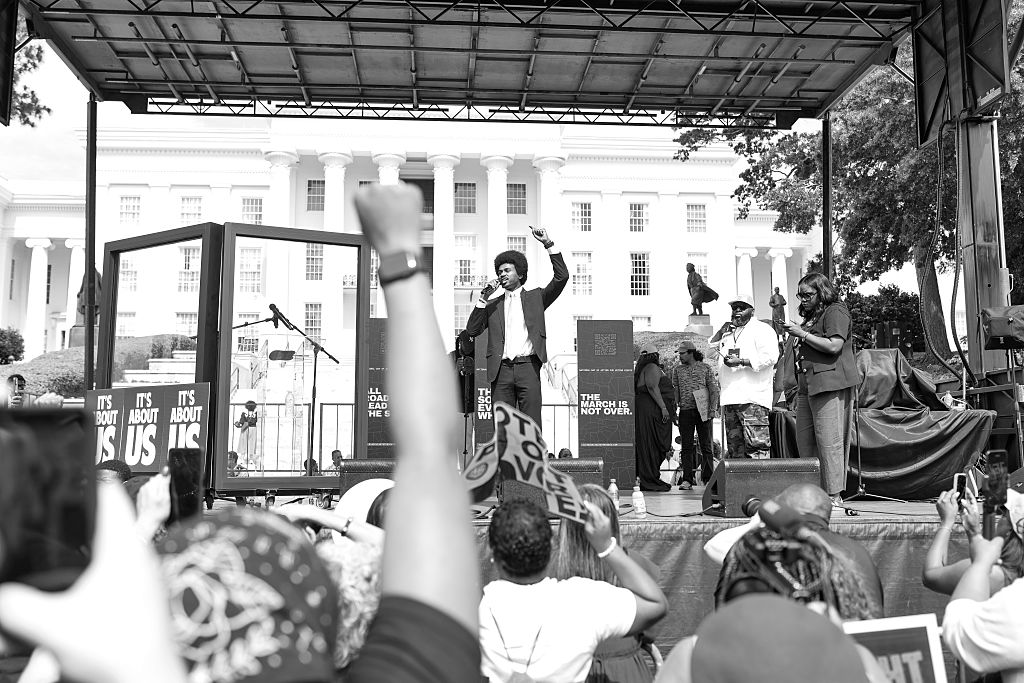
The All Roads Lead to the South rally, organized by a coalition of national and local civic engagement groups, took place outside the Alabama State Capitol, the same historic site associated with the 1965 Selma-to-Montgomery voting rights marches that became a defining moment in the fight for Black suffrage. The day began in Selma with a prayer service at the historic Tabernacle Baptist Church before participants took part in a silent march across the Edmund Pettus Bridge, the same bridge where civil rights marchers were brutally attacked during the 1965 “Bloody Sunday” demonstrations. After the walk, attendees traveled by bus to Montgomery, where they joined thousands more gathered for the rally.
“We’re here, Montgomery, not at a stopping point, but at a starting point,” Steven L. Reed, Montgomery’s mayor and the first Black person to hold the office, told the crowd during the rally on Saturday, according to The Guardian. “We’re here in this city because of the spirit, because of the courage and because of the commitment of our forefathers and foremothers who got us to this point.”
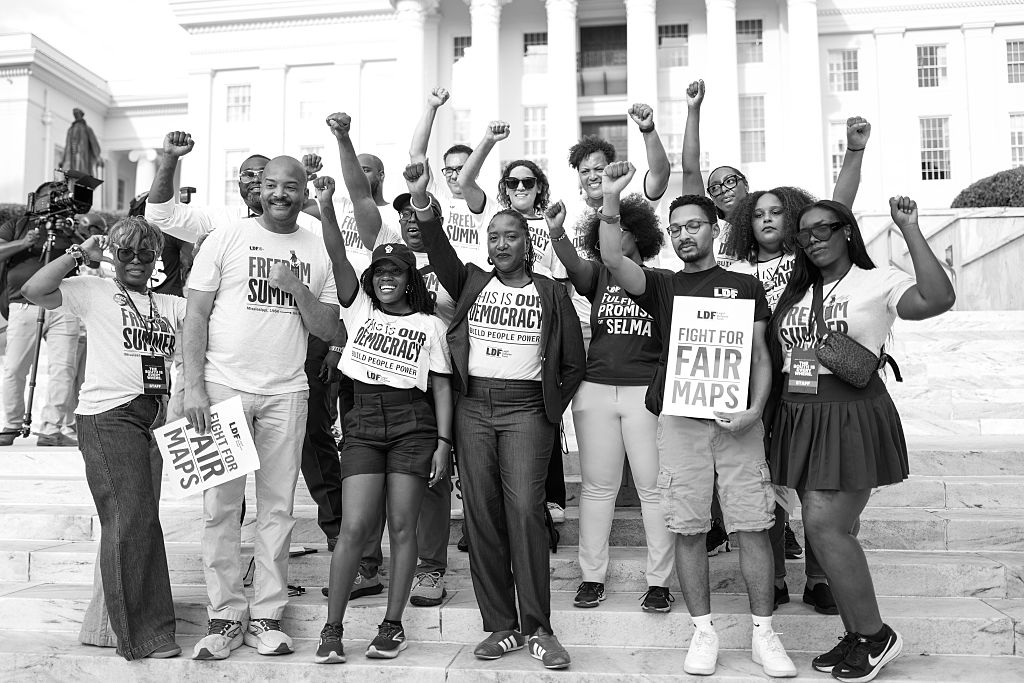
Tennessee State Representative Justin J. Pearson, Legal Defense Fund President and Director Janai S. Nelson, and New Jersey Senator Cory Booker were among the high-profile figures who stood in solidarity with rally-goers.
For many in attendance, the event was deeply personal. Families who once marched, protested, and suffered for voting rights now fear those hard-won protections are being dismantled.
“My grandmama, my momma, my mother-in-law—our ancestors did not cross that bridge, walk during the bus boycott, my cousins got locked in the First Baptist Church [in Montgomery], across from the police station in the ’60s, my other cousin got beat up by a horse up on Jackson Street—we didn’t do all that for this,” said Montgomery resident Carole Burton, according The Guardian.
Massachusetts Representative Ayanna Pressley also attended the historic rally, sharing video from outside the state capitol showing thousands of attendees chanting and demanding justice. Pressley sharply criticized Republicans and the Trump administration, calling them “hostile” and “anti-Black.”
“There are people in this hostile anti-Black administration that would rather Black Americans pick cotton than pick a president, than pick their Congressperson, than pick a Senator,” she said. “They want the representatives to decide who their voters are instead of the voters determining who their representatives are.”
Louisiana v. Callais: What are the arguments?
Civil rights organizations and voting rights advocates argue the April 2026 decision for Louisiana v. Callais effectively created a legal loophole that allows states to weaken minority voting power while avoiding accountability under the Voting Rights Act. The case centered on a clash between two major legal principles. On one side was the Voting Rights Act, which had previously required Louisiana to create a second majority-Black congressional district after courts found the original map diluted Black voting strength.
On the other side was a constitutional challenge brought by white voters led by Phillip “Bert” Callais, who argued that drawing districts with race in mind amounted to unconstitutional racial gerrymandering under the Fourteenth Amendment. The Supreme Court’s conservative majority, led by Justice Samuel Alito, ruled that states could justify district maps by citing explanations such as partisan advantage or incumbent protection, even if those maps weakened minority voting power. Critics say the decision gives states cover to enact racially discriminatory maps by simply labeling them “political.”
In a forceful dissent, Justice Elena Kagan warned that the ruling makes Section 2 of the Voting Rights Act “all but a dead letter” in many cases, and “threatens a half-century’s worth of gains in voting equality,” according to the Equal Justice Initiative. Civil rights groups echoed that concern, arguing the decision strips away one of the last remaining safeguards for voters of color.
Since the ruling, several Republican-led states have already moved to redraw voting maps in ways critics say weaken Black political influence. Tennessee and Florida have passed new congressional maps, while Alabama and Georgia are expected to face renewed legal and political battles over redistricting.
One of the most closely watched cases is Allen v. Milligan in Alabama. Following the 2020 Census, Alabama adopted a congressional map with only one majority-Black district out of seven seats, despite Black residents making up more than a quarter of the state’s population. Voting rights groups and residents sued, arguing the map illegally packed Black voters into one district while splitting other Black communities across several districts, limiting their ability to elect candidates of their choice.
A three-judge federal panel agreed that the map likely violated Section 2 of the Voting Rights Act and ordered Alabama to draw a new map. Although the Supreme Court temporarily paused that ruling, the lower court later found again in May 2025 that Alabama’s revised map was drawn with “racially discriminatory intent,” according to the Legal Defense Fund.
However, on May 11, the Supreme Court vacated that ruling, effectively allowing Alabama to proceed with its 2023 congressional map for the 2026 elections in light of the Louisiana v. Callais decision.
SEE MORE:
Supreme Court Justices Alito And Jackson Debate Voting Rights Decision


