The National Average Gas Price Is Finally Dipping Below $4
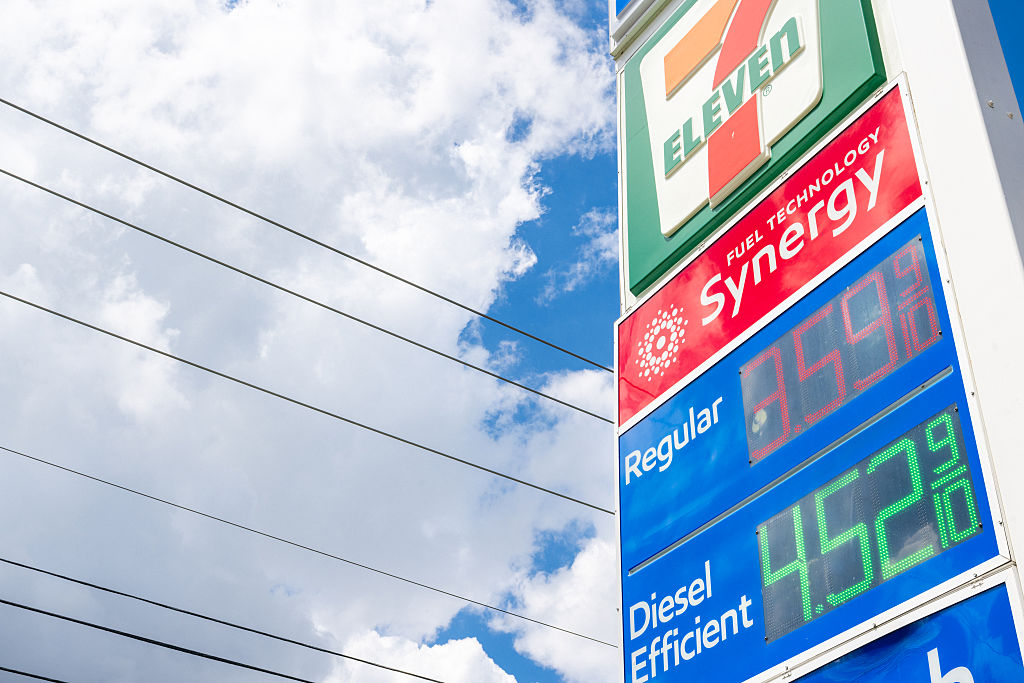
After months of egregiously high gas prices, there is finally some hope on the horizon. On Thursday, gas prices fell slightly below $4 nationwide.
When I say slightly, I mean it in the fullest extent of the word, as the New York Times reports that the average price per gallon is $3.99 nationwide. While it’s undoubtedly good to see oil prices dropping, AAA notes that gas prices are still 34% higher than they were when the conflict with Iran started.
The monthslong conflict with Iran effectively closed the Strait of Hormuz, through which a quarter of the global energy supply is shipped. This caused gas prices to spike almost immediately. In the days following the first strikes in Iran, I remember gas prices immediately surpassing $4 in my home state of Arizona, with prices eventually going as high as $4.99.
Gas prices had started to fall this week as the U.S. and Iran were signaling they were getting closer to signing a deal that would bring a permanent end to the conflict. On Thursday, Prime Minister Shehbaz Sharif of Pakistan announced that both President Donald Trump and the Iranian President Masoud Pezeshkian had signed the memorandum of understanding.
Sharif added that the agreement to reopen the Strait of Hormuz and lift the U.S. naval blockade would “enter into force with immediate effect.” Several ships had already begun passing through the Strait on Thursday.
Brent Crude, the international benchmark for oil prices, dropped by 1.4% on Thursday to $78.46 a barrel, while West Texas Intermediate, the U.S. benchmark, fell 2.2% to $75.10 a barrel. This is already a significant decrease from their respective highs of $119 and $112 a barrel throughout April and May.
Patrick De Haan, a petroleum expert at GasBuddy, told CBS News that prices should continue to fall “provided there isn’t a drastic reversal and the U.S. and Iran continue moving in a positive direction.” The deal guarantees 60 days of toll-free passage through the Strait of Hormuz, but it remains to be seen if Iran will continue to allow free passage beyond that point or if it will impose a toll as the nation’s leaders regularly suggested throughout the conflict.
“One note that could improve the timeline is that Iran is allowed to sell oil on markets again, which could speed up the recovery for global oil inventories,” De Haan said in an email to CBS News. The deal does grant waivers for Iran to export its oil, so depending on how things go in the next 60 days, we could see gas reach its pre-war prices by the end of this year, beginning of next year.
Another point worth observing in recent months is whether the price of goods will go down. Increased oil prices have had a ripple effect on costs, as many goods are transported across the U.S. through diesel trucks. One would hope that as diesel prices decrease, so too will the cost of goods, but never count out the power of corporate greed.
SEE ALSO:
Inflation Hit Highest 1 Month Spike In 4 Years Due To Iran War
Gas Prices Over $4/Gal. In All 50 States. Trump Says It’s ‘Peanuts’