Nicki Minaj Summoned The Ghost Of The 'Hottentot Venus'
At Trump’s Summit, Nicki Minaj Summoned The Ghost Of The ‘Hottentot Venus’
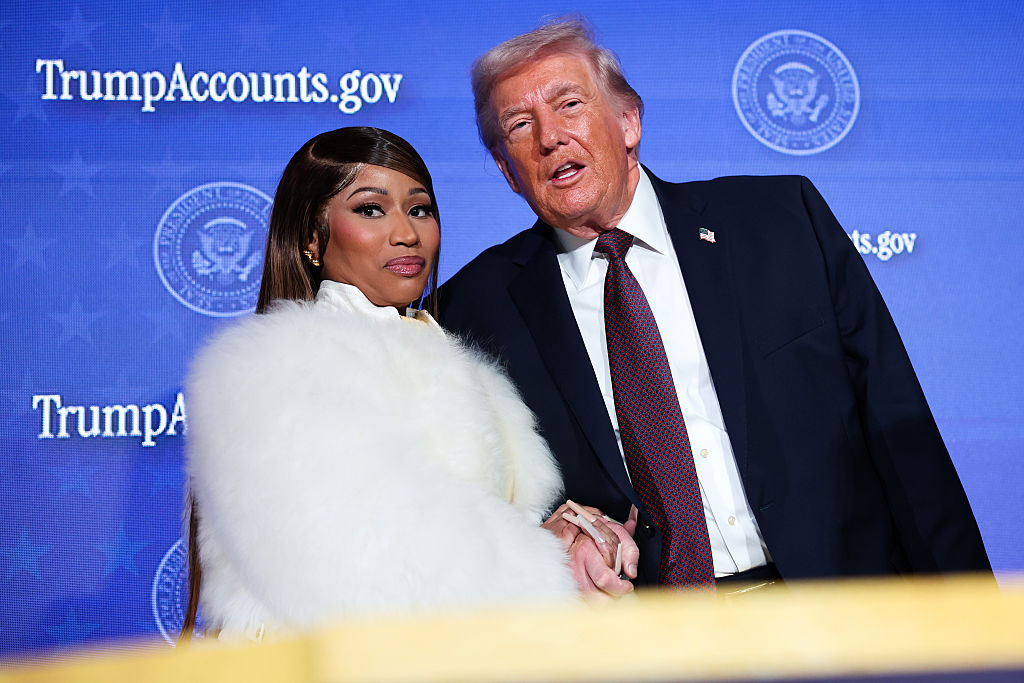
When Nicki Minaj walked into that Trump Accounts Summit event a few days ago, wrapped in white fur, she didn’t just enter a room. She arrived lacquered, weaponized, and curated for impact.
Her hair fell smooth and pin-straight with that precise, studio-perfect side part and not a strand daring to misbehave. The nails were colorful, long, and reminded me of my parrot’s talons. And her wide, glassy, unnervingly still eyes carried that overly polished, pageant-mannequin quality that makes you wonder whether you’re looking at a person or a projection.
At first glance, it registered as glamour. But history teaches us to look twice at moments like this because spectacle has always been one of power’s favorite disguises. Minaj didn’t just attend an event; she entered a historical script
A Black woman with a pronounced, hyper-visible body stepping into an overwhelmingly white space of political power has never been a neutral act in Western history. Never. And pretending otherwise is how spectacle disguises itself as celebrity.
Look at her body in that space. Not her fame or her music catalog. Her body. Them wide hips. That full backside and curvature that pushes outward instead of disappearing inward. The way her silhouette refused the straight lines, muted colors, and narrow restraint of white political uniforms. Her visually abundant body did not blend in that room built on the aesthetic discipline of restraint. It interrupted, protruded, and announced itself visually before she even said a word. And that was the point.
This is where the photos of Minaj collide head-on with the history of Sarah Baartman, who was grotesquely nicknamed the “Hottentot Venus.” Baartman was dragged into white European spaces and displayed precisely because her body did not conform to white proportions. Her hips and buttocks were isolated, framed, and made to carry meaning. She was paraded naked or semi-naked, sometimes led on a rope, for white audiences to gawk at, poke, theorize about, and eroticize under the guise of science, curiosity, or entertainment. Her body was the attraction, and her humanity was irrelevant.
Fast forward two centuries, and the costumes have changed, but the gaze has not.
Nicki Minaj was not naked at that event. She was not on a rope. She was rich, famous, and wrapped in luxury. And yet the visual labor her body performed in that room followed the same logic. Her curves became the spectacle that made the space feel transgressive, exciting, and consumable. Her presence did not signal power-sharing. It was giving “display.”
Minaj did not need to be coerced for the spectacle to work. Spectacle does not require ignorance or force. It simply requires contrast. It requires a body that can be read as “excess” against a background that insists it is neutral.
Every white man in that room was allowed to look like authority without decoration. Look at their aging faces, soft bellies, ill-fitting suits, and bodies dissolved into power. Minaj’s body could not dissolve. It was required to perform.
And then there are the photos of her clasping Donald Trump’s hand. Hugged up. Pressed close. Fur against suit. Acrylic nails wrapped around mottled, aging flesh. Those images are stomach-turning not only because they are visually jarring, but because they are transactional.
The photos send the visual message that Black desirability, Black femininity, and Black excess can be brought into proximity with white authoritarian power without threatening it. In fact, it makes that power look softer. Cooler. Less monstrous. More human. Minaj’s body does reputational labor that Trump’s body cannot.
Power has always understood that domination looks less frightening when reflected through beauty, celebrity, and desire. A spectacular Black body does what policy cannot, which is anesthetize the public. And proximity to a spectacular Black body allows whiteness to rehearse openness while surrendering absolutely nothing.
This is why the Trump orbit loves images like this. Not because they respect Nicki Minaj, Black women, or Black culture, but because a Black body in that space does something useful. It reframes whiteness as open-minded. It reframes authoritarian politics as culturally adjacent while borrowing glamour without surrendering control.
There’s more …
The fact that she was wearing white fur matters here. Think about…fur is not just fashion. Fur is conquest made wearable. It is the skin of an animal turned into status. Draped over Nicki’s body, it amplifies the contrast even further. What we see is excess on excess and luxury layered onto a body already coded as too much. It turns her into a living exhibit that’s plush, touchable, and consumable.
Sarah Baartman was exhibited as proof of white fantasies about Black female sexuality. Nicki Minaj, in that room, became proof of white fantasies about racial proximity and proof that whiteness can touch Black spectacle without being changed by it.
And what’s so dang tragic is that Nicki Minaj didn’t seem to understand that she was the spectacle.
Y’all seen it. She looked comfortable, pleased, and fully present. She appeared to believe she was a participant rather than a racialized political prop. That belief is what makes the image so disturbing. Because history has taught us that Black women do not have to be unaware to be used, but the cost is always higher when the gaze is mistaken for power.
Her body, in that space, did not assert autonomy. Instead, it told a story on behalf of white men who did not have to undress themselves, explain themselves, or offer anything in return. It allowed them to be seen next to Black femininity without being accountable to Black life. Her presence told white audiences: we are not racist, look who is here.
Sarah Baartman died without ever escaping the gaze that defined her. Her remains sat in jars for generations while white institutions congratulated themselves on progress. Nicki Minaj is alive, wealthy, and influential, but the image reminds us that no amount of success exempts Black women from being reduced to visual labor when they step into white power spaces.
American power has always staged these visual reconciliations as moments designed to suggest racial intimacy while leaving the underlying hierarchy untouched. The spectacle has modernized. The staging is more elegant, and the lighting is better. But the gaze is almost exactly the same.
Dr. Stacey Patton is an award-winning journalist and author of “Spare The Kids: Why Whupping Children Won’t Save Black America” and the forthcoming “Strung Up: The Lynching of Black Children In Jim Crow America.” Read her Substack here.
SEE ALSO:
Don Lemon’s Arrest Is A Warning Shot At Black, Independent Journalists