Surya Bonaly Made A Historic Backflip When It Was 'Illegal'
Funny How It Became ‘Revolutionary’ When A White Skater Did A Backflip A Black Woman Mastered Decades Ago
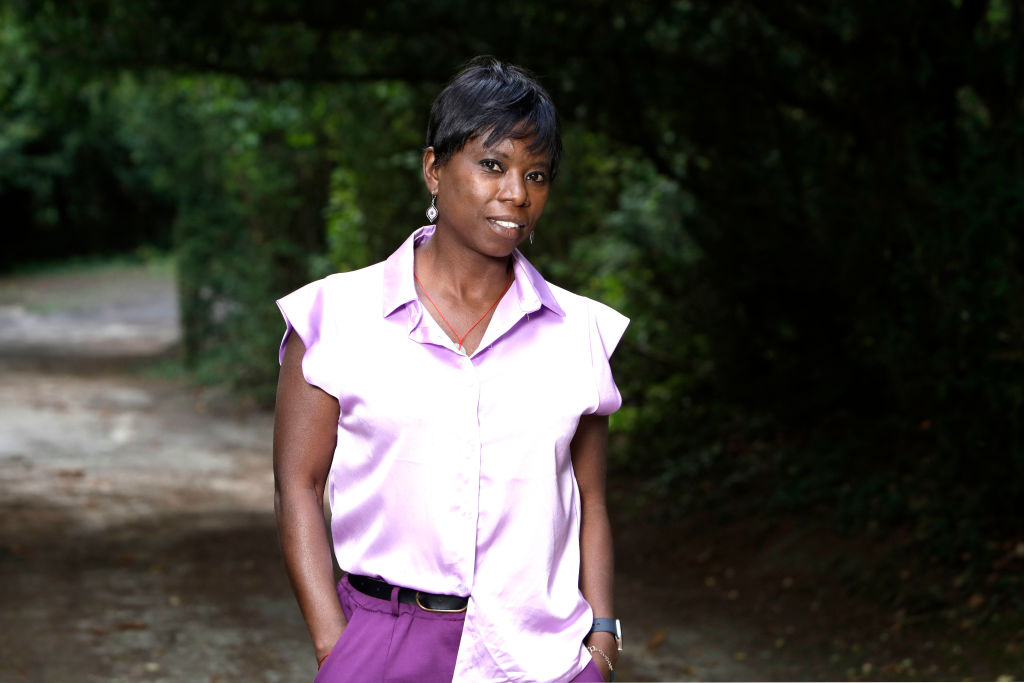
As the sports world celebrates Ilia Malinin for landing a backflip at the 2026 Winter Olympics in Milan-Cortina and pushing the limits of figure skating with boundary-breaking athleticism, it’s worth noting something the headlines keep leaving out: Surya Bonaly, a Black woman, did it first. She did it decades ago. And she did it more dangerously, more defiantly, and under rules, scrutiny, and politics far harsher than anything today’s skaters face.
As coverage swells around today’s generation of male technical power skaters and their flirtation with once-taboo acrobatics, it raises a bigger question about memory, race, and authorship in elite sports. Because this isn’t just a conversation about a backflip. It’s about who gets remembered as innovation’s architect, who gets pushed out of origin stories, and how in a political climate already hostile to Black history, media storytelling quietly reshapes who the public believes pushed sport forward in the first place.
Right now, coverage of Ilia Malinin, the 21-year-old American skater nicknamed the “Quad God,” reads like the arrival of a new era. Broadcasts and sports outlets describe his skating as electric, revolutionary, boundary-shattering. They say he has the kind of technical dominance that signals the future of the sport. NBC coverage called one Olympic performance “near-perfect,” describing crowds ready to explode before he even finished skating. Commentators talk about him as if he represents the next evolutionary step in men’s figure skating.
And to be clear, Malinin is extraordinarily talented. This is not about tearing down one athlete. This is about examining which stories get amplified and which ones get buried. Because that breathless language lands very differently if you know the sport’s history, and if you remember who was penalized, dismissed, or treated like a novelty for pushing those same physical boundaries first.
Long before this era of technical hype cycles, Surya Bonaly, a Black French adoptee, was doing backflips in the late 1980s and 1990s, when figure skating was aggressively policing what counted as “proper” skating. The backflip had already been banned in international competition since the 1970s, officially under the language of safety. But like many rules in aesthetic sports, it was also about control over what skating should look like, who should perform it, and how visible athletic risk was allowed to be.
Then came the moment that should live in every Olympic montage but somehow rarely does. At the 1998 Nagano Olympics, Bonaly, who had already been pushed out of medal contention and was openly frustrated with judging politics, ended her routine with a backflip and landed it on one blade. Not two feet. One blade. That landing is objectively harder and more dangerous than the traditional version.
That moment was pure defiance and technical brilliance. And at the time, it was treated less like athletic mastery and more like spectacle, like Black girl attitude, and proof she wasn’t playing by the sport’s unwritten rules.
When Bonaly protested the way judges were scoring her by removing her medal at the 1994 World Championships, wire coverage at the time described it as a “temper tantrum,” framing her protest as emotional instability rather than a protest against a system many athletes had already criticized. You could hear it in how people talked about her.
When Bonaly did the backflip in Nagano, commentator Scott Hamilton dismissed the move as crowd play, warning viewers, “She’s doing it to get the crowd. She’s going to get nailed.” The crowd booed her, and the message was clear: this wasn’t brilliance, it was performance.
Years later, even Bonaly herself would point out the double standard, noting that she had once been called reckless and untethered for pushing limits that are now celebrated as innovation. And Black skating analysts and observers have said plainly what the sport often avoids saying out loud: things Black athletes were once mocked or punished for are routinely reframed as revolutionary when performed by white athletes.
Reacting to the latest praise being heaped on a white male figure skater, Bonaly said: “I’m not crazy, but I was called untethered, and now it’s OK.”
The media’s selective amnesia about her backflip matters. Because remembering that she did it first means remembering the racial politics that shaped how it was received. If they remember Bonaly did it first, then they have to talk about why it was framed the way it was when she did it. They have to talk about the aesthetic policing of Black bodies in a sport built on quiet white ideals of grace and restraint. They have to talk about judging systems long criticized for nationalism, bias, and gatekeeping. It is much easier to celebrate acrobatic “evolution” now than to revisit why Black athletic rebellion was once framed as disruption instead of brilliance.
I will never forget watching Surya Bonaly stand on that medal podium in 1994, crying, and taking that silver medal off her neck. I was a college basketball player moving through mostly white coaching spaces where I was constantly described with animal imagery. I was used to hearing the stereotypes that I played off instinct and raw talent, but not intelligence. That my power was natural, not disciplined. That I needed to be controlled to be acceptable.
So when I watched her on that podium, I didn’t just see a skater upset about a medal. I saw a Black woman being forced to perform gratitude inside a system that had already decided what she was allowed to be. I saw what happens when you are asked to be exceptional but never too powerful, talented but never too disruptive, and visible but never fully human. Watching Bonaly cry while cameras rolled felt like watching someone realize that excellence was never going to be enough to make the system fair.
And I remember thinking, even as a young athlete still trying to navigate those spaces myself, that what she did by taking that medal off was bigger than sports. It was about refusing to pretend the system was neutral and refusing to smile for a story that erased what it took to survive inside it.
Fast forward to now, and you have wall-to-wall celebration of acrobatic spectacle as proof of evolution. Language about redefining skating. About rewriting technical ceilings. About changing what’s possible. And in much of that coverage, there is little public reckoning with how the sport treated the Black woman who pushed those physical limits decades earlier under harsher scoring scrutiny, aesthetic policing, and far less institutional protection.
This is what sports memory laundering looks like.
Figure skating has long been one of the most culturally policed Olympic sports. It has long been a space in which whiteness has been quietly coded into ideas such as elegance, purity, line, and tradition. Bonaly disrupted that. She challenged judging systems. She refused to reshape herself into the fragile archetype judges historically rewarded. She brought visible power to a sport that preferred power hidden under softness.
And right now, in a moment when political power is openly trying to control what history is taught and whose stories are centered, these cultural rewrites matter more than ever. Because this is how erasure works in the modern era. It doesn’t always happen through bans. Sometimes it’s through celebration that conveniently forgets who made celebration possible.
The real problem has never been a shortage of Black innovation. There has always been a shortage of historical honesty from people invested in pretending innovation came from somewhere else.
SEE ALSO:
Howard University: First HBCU With Figure Skating Team
Black-Owned Skating Academy Strives To Make Sport Accessible