Jesse Jackson's Blueprint For Defeating US Extremism
Jesse Jackson’s Campaigns Offer Blueprint For Defeating US Extremism
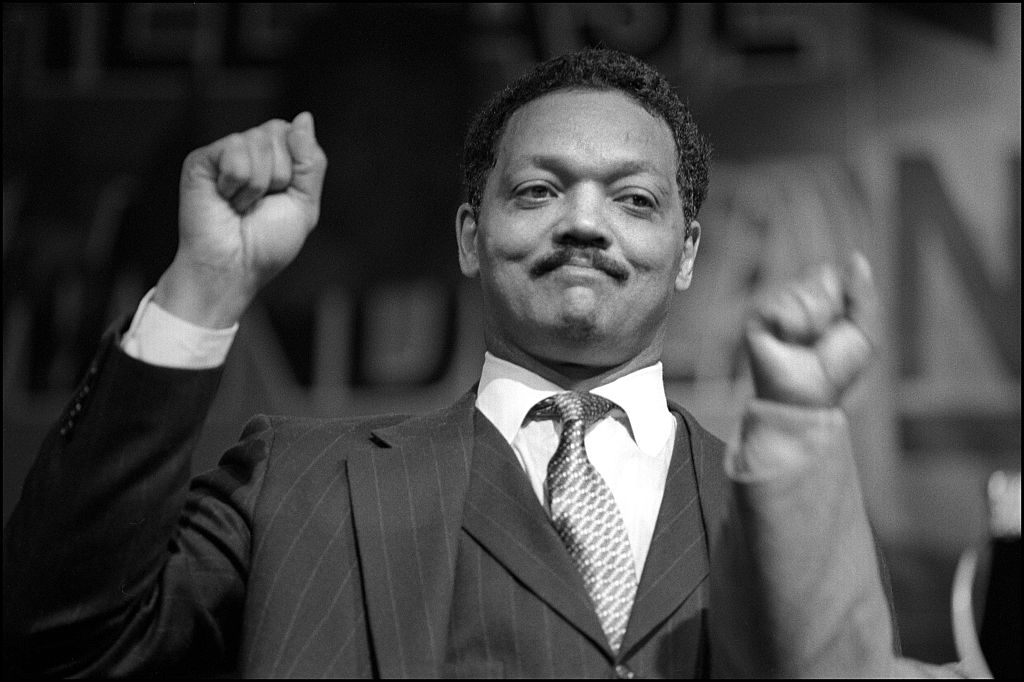
Over 40 years after his first presidential campaign and call for a Rainbow Coalition, Rev. Jesse Jackson’s transformative presidential campaigns offer a framework for sustaining opposition to extremist economic and political policies. His political challenge was as much about the presidency as it was about shifting culture and values.
Through his work and words, Jackson sought to build collective power at scale. A look back at old clips and articles offers a clear throughline from his rebuke of the Reagan-Bush administration to the authoritarianism and economic exploitation of now.
Embedded in the simplicity of “I am Somebody,” or the constant grounding in hope, were mantras for sustaining ourselves and our communities in the face of adversity.
When he spoke of hope, it was an invitation to dream and envision what could be rather than lament what was. And Jackson understood that elections and campaigns offered a possible vehicle for the ideas and values necessary to change this country.
In many ways, Jackson’s 1984 campaign moved many progressive ideals from the margins to the political mainstream. In fact, several of the ideas credited to Sen. Bernie Sanders were championed by Jackson before it was cool. He called for a shift in national priorities, with the government investing less in militarism and more in domestic affairs and community investments.
He offered a vision and framework of progressive political organizing that sought to engage the diversity across American communities. Jackson took on race and class. It wasn’t one or the other.
As outlined by Frontline in March 1984, Jackson ran on a clear pro-democracy, anti-racist, economic justice platform. “Peace Abroad, Justice at Home” was a common refrain of the campaign.
Jackson directly challenged the political status quo on the nuclear arms race and the failure to implement and enforce the Voting Rights Act of 1965. He supported the Equal Rights Amendment and disability rights.
The vision of a united coalition of diverse people was integral to Jackson’s clear understanding of power and coalition-building. Building power isn’t only about who we elect or have leading organizations. It’s directly related to the agency and engagement of those previously rendered powerless.
Jackson also knew that organizing against political elites in both parties required confident defiance and, where necessary, a call-out of how white moderation would not get us free. He called not only for new leadership but also for a new direction for a country languishing under the harm caused by the Reagan-Bush administration.
“The issue is not decency and dignity, since all of us have that, that cancels itself out,” Jackson said in a 1984 campaign speech. “The issue is direction. A good man going in the wrong direction won’t help you very much.”
Being decent and moving with dignity was the floor. Jackson challenged America to demand more of its leadership and warned about otherwise good people who travel in the wrong direction.
A challenge millions are taking up today in the face of extreme abuse of people and power by the federal and several state governments. As a major candidate for president, Jackson voiced strong positions on Apartheid in South Africa, the dispossession of Palestinians, and a virtual disregard for the non-white Global majority.
He offered a new vision of what a so-called “Super Power” could be in the world if grounded in human rights and the basic values of fairness and justice. Like Jacksoon, we cannot divorce our domestic concerns from the implications of the United States’ imperialist agenda.
Communities across the country are navigating this duality as they defend their neighbors against violent ICE raids or attempts to steal our elections before they even begin.
The choice Jackson laid out remains clear today. Those who claim to ascribe to a higher moral authority cannot sit idly by as a morally bankrupt society destroys our communities and families. We must name the harms, call out who is causing them, and invite our communities to build shared political and economic power.
Those seeking office and clamoring for our votes would be wise not to simply mimic Jackson’s words and cadence, but to embrace the organizing he used in his campaigns. It’s a strategic approach that builds on generations of Black political organizing from Reconstruction to the Civil Rights Movement to the transformational campaigns in 2018-2025.
Similar to the playbook employed by organizers with the Student Nonviolent Coordinating Committee in the deep South, Jackson nationalized grassroots organizing, engaging potential voters who had been overlooked and discounted. Instead of waving his finger at people about what they ought to do, he sought to inspire them to be part of the change they needed.
Idealistic to some, but the promise of both campaigns helps us navigate how we move forward and not just simply as an afterthought in the 2026 political calculus. While only a portion of Jackson’s work, both political campaigns demonstrate what can happen when our communities organize around a united platform.
We are at the precipice of a momentous shift. Remembering Jackson’s impact opens space to call into question all the ways the current system and the political machines that run it do not serve our interests.
As this country approaches a monumental birthday, we have an opportunity to shift the balance of power from the elite clique that has run America for 250 years. Our collective salvation lies not in the ballot or the parties on it, but in our ability to sustain civic engagement and political organizing beyond the status quo.
SEE ALSO:
Civil Rights Leader Jesse Jackson Dies at 84