What Lawrence Ross Taught Us About Tangible Solidarity
More Than A Moment: What Lawrence Ross Taught Us About Tangible Solidarity
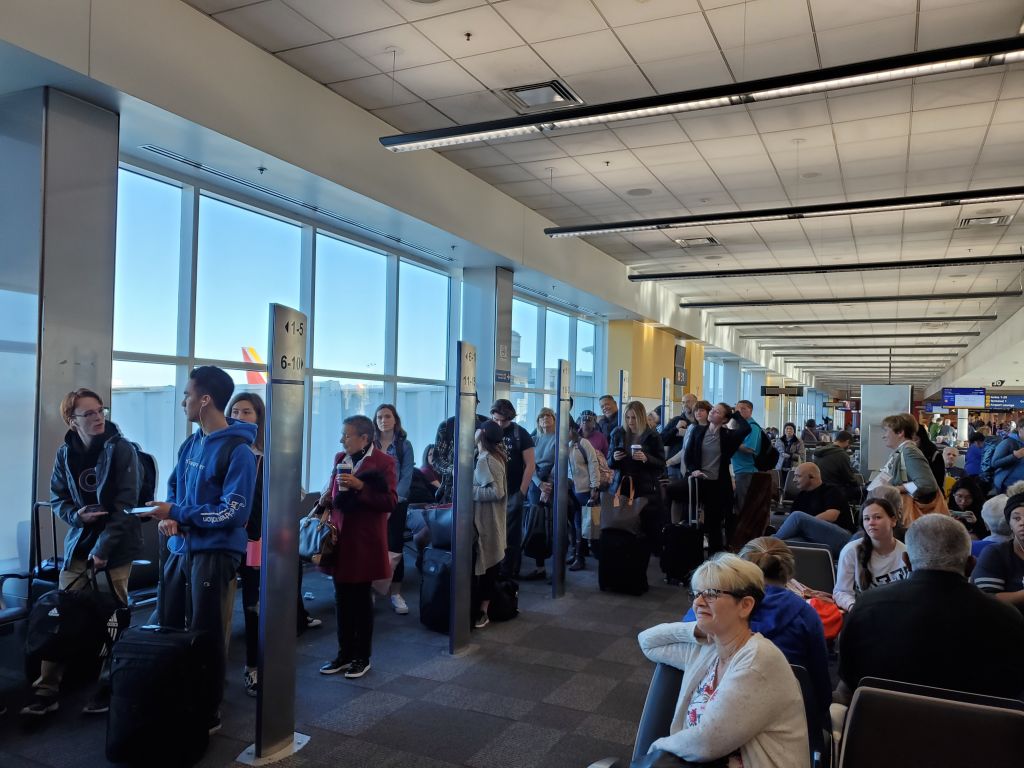
The boarding terminal of a Southwest Airlines flight is its own fresh hell—a cacophony of rolling luggage, grunts, and sharp elbows, where folks are fighting for boarding access like it’s a scene in The Hunger Games. It’s a space where the rules of civil society seem to be suspended in favor of a frantic scramble for overhead bin space and priority seating.
This chaos has only intensified as travelers navigate the carrier’s 2026 overhaul of seating and ticketing guidelines. Even though passengers are now assigned specific seat numbers, the struggle with boarding lines hasn’t disappeared. Instead, boarding has morphed into a new kind of friction, creating even more frustration for passengers trying to move through an airline system that feels like it’s constantly moving the goalposts.
For Black women, these moments of boarding aren’t just about travel; they’re the front lines of a persistent warfare where our right to take up space is constantly challenged. Listen, if you’re a Black woman who flies frequently, you know exactly what I mean.
As I scrolled Facebook recently, I was stopped in my tracks by a post from Lawrence Ross— a fellow scribe and lover of Black people and culture, and the author of The Divine Nine and Blackballed. He described a scene from a recent trip he took that made my stomach drop immediately because I’ve lived it, and I’m almost certain that if you’re a Black woman, you have too.
While waiting to board, Ross witnessed a white man decide to appoint himself the enforcer of the boarding process. This man began to chastise and bully a Black woman attempting to board his and Ross’ flight, treating her as though she was “skipping” in a process that’s already chaotic by design. This wasn’t a mere disagreement between travelers; it was a performance of entitlement—the familiar, ugly spectacle of a man attempting to shrink a Black woman’s presence until she felt small enough to disappear into the grime of the terminal carpet.
What happened next was a modern-day manifestation of an old, ancestral trauma. In moments like these, Black people are still expected to “show their papers” to prove we belong—to prove we have the right to stand in the front, to sit in the seat we paid for, to exist without harassment. It’s a psychological haunting that mirrors the era of enslavement, when our ancestors were required to carry freedom papers just to move through the world without being harassed, harmed, or re-enslaved. The demand to “prove it” is a tool of control, and in that terminal, that man was reaching for a whip he thought he still had the right to crack.
In his account, Ross describes stepping into the line of fire, providing a masterclass in care. He didn’t wait to see if her boarding pass was in order. He didn’t pause to calculate if she was “representing the race well.” He saw a sister being cornered and diminished, and he became her anchor. He chose to be loyal over being “logical,” absorbing the heat of that man’s vitriol so she wouldn’t have to carry the weight of that entitlement alone. He understood that in a moment of racialized bullying, the “truth” of the line position matters infinitely less than the humanity of the person being hunted.
This kind of open, uncalculating care from a Black man is a balm for a wound many Black women carry in silence. But let’s be honest: the deepest hurts don’t always come from the “outside.”
Black women have gotten used to the “calculations” of brothers who wait to see if we’re “worthy” of defense before they speak up. We’ve even grown used to the “think pieces” that dissect our tone or “attitude” while we’re still bandaging our wounds. To see a man of Ross’ stature move with such protective love is a reminder of what brotherhood is supposed to look like. It reminds us that we’re worth defending—no questions asked, no audit required.
Ross’ reflections require us to be honest about the hour we’re living through.
The false sense of security we might’ve tucked ourselves into in past decades has evaporated. We’ve returned to a climate that feels hauntingly similar to the one Malcolm X navigated when, in 1967, he famously declared: “The most disrespected person in America is the Black woman. The most unprotected person in America is the Black woman.”
Today, this racialized and sexualized violence is bold and overt. It meets us at the grocery store, in our offices, and, apparently, at the airport gate. In times this dangerous, silence is not a shield. And as Audre Lorde so sharply reminded us, “your silence will not protect you,” and it certainly won’t protect the most vulnerable people in our collective community. Research on “Racial Battle Fatigue” shows that Black women experience higher levels of psychological distress due to a constant accumulation of microaggressions. When a man bullies a woman in a jet bridge, it’s not a localized incident; it’s part of a systemic pattern of gendered racism designed to keep us in a perpetual state of “survival mode.”
Some argued Ross shouldn’t have supported the Black woman passenger because “she was doing too much” or “she probably did skip the line.” Others even suggested that standing up for her wasn’t worth the risk of Ross landing on a “no-fly list”—as if the possibility of a travel inconvenience should outweigh the necessity of a Black woman’s safety. Thankfully, Ross refused to retreat, doubling down on his decision to stand in the gap. In those comments, I saw the jagged shards of the kind of deep misogynoir that continues to fragment our community.
Perhaps what was most heartbreaking, though, was seeing how many of these dismissals came from other Black women. When we join the chorus of people diminishing our own through the lens of respectability politics, we’re essentially doing the state’s work. We’re reinforcing the lie that our vulnerability is a character flaw and that our right to safety is a prize to be won through “good behavior.” Not only do Black women deserve protection, but we deserve grace, too. Full stop.
We have to stop asking if Black women “deserved” to be bullied and start asking why we’re so comfortable watching that happen. The way our ancestors survived wasn’t through individual excellence; they survived because they understood what Gwendolyn Brooks meant when she wrote: “We are each other’s harvest; we are each other’s business; we are each other’s magnitude and bond.”
Solidarity is a revolutionary act of radical protection. It means moving in togetherness even when it’s unpopular or uncomfortable. Real solidarity is an infrastructure of care that should catch all of us before we fall, regardless of why we fell in the first place. It’s time we stop being the gatekeepers of our own protection and start being the web of support that creates safe spaces for all of us—no matter how messy, loud, or “unrefined,” we might be presumed to be.
Lawrence Ross’ actions remind us that we’re facing a bold and overt racialized violence that requires us to step up and step in. He’s clearly answering the call. Will you?
Josie Pickens is an educator, artist, cultural critic, and abolitionist strategist and organizer. Find her and her musings on Instagram and Threads at @jonubian.
SEE ALSO:
On Tiffany Woods, Disaster, Displacement, And Life Without Parole
I Was Born In Houston, Gave Birth There, And Almost Died There