Megan Thee Stallion, De-centering Men, And Choosing Ourselves
The Truth Of The ‘Long Before’: On Megan Thee Stallion, Decentering Men, And The Radical Choice To Choose Ourselves
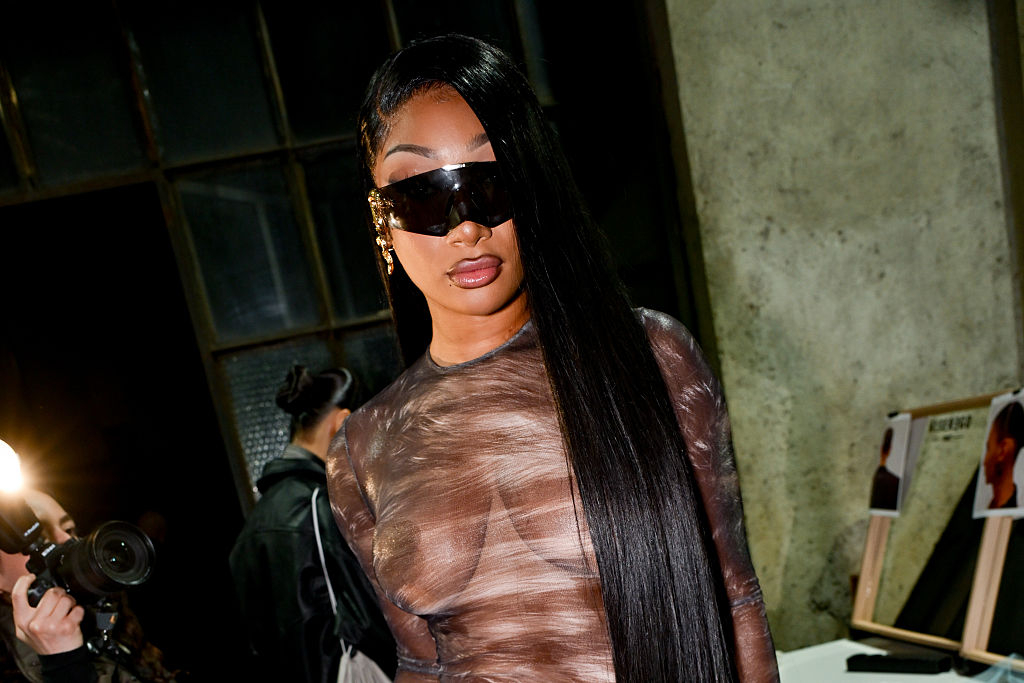
When Megan Thee Stallion spoke out this past week about the end of her relationship with Klay Thompson, the headlines focused on the betrayal of infidelity, because that’s a story the world knows how to tell.
Cheating is a loud, jagged thing, after all—a line many people draw in the sand when they’re deciding whether to stay or leave. But what she also said that we aren’t discussing—the admission that she’d been “holding him down” through horrible treatment and mood swings long before discovering the cheating—is the part that felt the most heartbreaking to me. That’s where I saw myself most in her story. That recognition of the “long before” is the quiet part we often don’t want to say out loud. It’s the truth that many of us recognize in the mirror and in the hushed phone calls we make to our girlfriends late at night, when we know we should leave, but we don’t.
For Meg, that “long before” moment will leave her picking up the pieces of her shattered heart while the public scrutinizes her life and her choices—both past and present. For Black women like Ashanti Allen, Cerina Fairfax, Nancy Metayer Bowen, and countless others, that “long before” reached a much more tragic end. Mistreatment doesn’t always arrive with a visible bruise. Sometimes it’s just a slow thinning of the air in your own home. It’s the way your voice starts to trail off because you’re anticipating a sharp, mean-spirited comeback, or the way a room feels smaller the moment someone who’s harmed you walks into it.
We watched Megan, a woman whose light fills every stage she stands on, admit that she was allowing her light to be dimmed while the world was still applauding her for being chosen, and for being “down.”
Even in the wake of the split, we’ve seen the public reaction fall into that familiar, ugly pattern of shaming the woman—digging up her past or circulating graphics of her former partners as if her mistreatment was somehow her own fault. It’s a clear way to tell Black women that if we aren’t the “perfect” victim, we don’t deserve care and protection.
None of this is new. Each reminder feels like the peeling away of a scab that’s just beginning to heal. So, in all the noise, I want this to be a gentle offering for the women who’ve lived in that “long before”—for the ones currently negotiating with their own peace, trying to figure out if the weight they’re carrying is love or just a very heavy, very lonely bad habit.
We’re taught so early that our strength is a container meant to hold everything that others refuse to carry. Our literary mother Zora Neale Hurston wrote in 1937 that, “De nigger woman is de mule uh de world so fur as ah can see.” Too little has changed around societal and communal expectations of loyalty since then. For us, loyalty is still framed as something holy, a spiritual requirement offered as sacrifice for our belonging. We’re socialized to be the architects of emotional safety for Black men, building fortresses around their vulnerabilities while we stand outside in the rain. We manage their moods, we curate their public images, we soften the blows of a world that we know is cruel to them, never pausing to ask: who’s holding the umbrella for us?
The numbers tell a story our bodies already know, even when we try to ignore it. According to the Violence Policy Center, Black women are murdered by men at nearly three times the rate of white women. In cases where the relationship could be determined, up to 91% of the victims were killed by someone they knew. While we make up a small fraction of the population, the burden of intimate partner and familial violence we carry is disproportionately massive. The reality of this struggle transcends the simple misfortune of bad dating choices; it’s rooted instead in a culture that frames our capacity to endure the absolute worst as our highest virtue.
Being the primary caregiver of a grown man’s ego carries a very specific kind of exhaustion. We see the patterns everywhere—not just in celebrity news, but in the stories that break through the noise of our daily lives. The rising reports of violence involving Black women serve as haunting reminders of the silent public health crisis we’re navigating. These tragedies represent the logical end points of a culture that expects us to give infinitely of ourselves while asking nothing of the men we’re tasked with holding up. Culturally, we’ve been told that to leave is to fail. To walk away when the mistreatment is “only” emotional is often framed as an abandonment of our families and our community.
We stay because we’ve been taught that our value is tied to being chosen, and then how much we can survive once we are. According to a report by the Institute for Women’s Policy Research, more than 40% of Black women experience physical violence from an intimate partner during their lifetimes. And we stay because the world makes the alternative feel like betrayal. But our bodies know the truth long before our minds have named it. It’s in the way your stomach tightens when his key turns in the lock. It’s in the way you started getting headaches every Friday night—anticipating the extra time you’ll have to spend with your abuser over the weekend. It’s the silence that feels like holding your breath underwater—praying that at some point you’ll be able to come up for air.
Decentering the male gaze and the male ego is the most protective thing we can do for ourselves. By refusing to measure our worth through the narrow lens of whether a man’s chosen us, we watch the bars of the cage finally dissolve. There’s a liberation that comes with caring less about being “good” or “loyal” in his eyes; in that space, it becomes infinitely easier to recognize when we aren’t being loved well. We stop performing for an audience that doesn’t appreciate the sacrifice. As the desperate need to prove our devotion dies, the instinct to protect our own lives finally gets the room it needs to breathe. It’s much harder to trap a woman who no longer looks to a man to tell her who she is or what she’s worth.
Choosing to decenter the needs of men who don’t truly see us and love us in the ways we deserve isn’t an act of war against Black men or the Black community; it’s a return to ourselves and a way for us to keep ourselves safe. It’s an acknowledgment that we can’t be the only ones doing the work of repair in a relationship. Our survival requires us to take that same keen, sharp-edged awareness we use to navigate the world and turn it inward. It means trusting the flinch. It means honoring the part of you that wants to leave, even when you can’t point to a visible scar. We don’t owe the world our destruction in exchange for the title of “strong,” or “good,” or “down.”
In fact, we don’t owe anyone versions of ourselves that are smaller, quieter, or more manageable just so the men who aren’t committed to caring for us can feel larger, stronger, or more manly. I’m glad Meg chose herself by not only leaving, but also by speaking up on why. She gave us more than a headline. She gave us a mirror to hold to our faces and to the faces of the men we surround ourselves with, who either harm us or make excuses for the men that do. She’s showing us that even the most powerful among us can find themselves in the “long before,” and that there’s absolutely a way out. We’re allowed to want a love that doesn’t require us to disappear or negotiate our safety.
Moreso, we’re allowed to trust the voice that tells us that we deserve to be handled with the same tenderness we’ve given so freely to everyone else. We must move with the clarity of a woman who knows she’s her own best protector.
Sis, let the finality of your choice be your peace. There’s an entire world waiting for the version of you that isn’t tired of carrying someone else’s weight. You’re allowed to lay it down. You’re allowed to choose you.
Let the doors you close be as sacred as the ones you open.
SEE ALSO:
Klay Thompson’s Job Was to Protect Megan Thee Stallion, Even From Himself
Klay Checks Podcast Bros Over Crude Comments About Megan


