Black People Have Been Boycotting The Same Insult For 40 Years
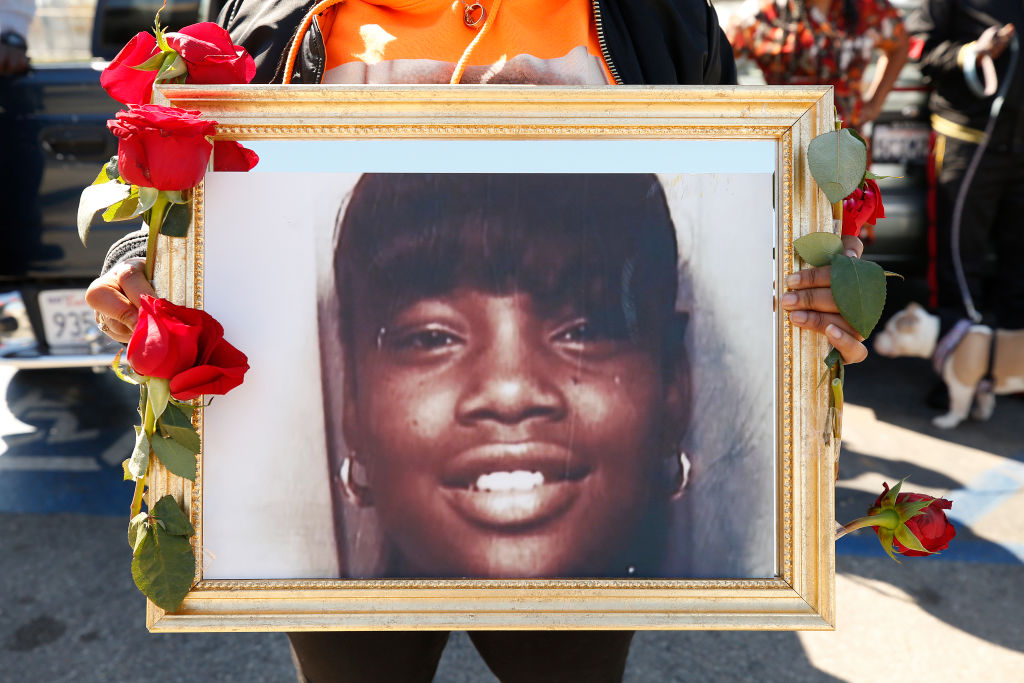
Come, go back with me to Los Angeles, March 16, 1991.
It’s barely two weeks after the videotaped beating of Rodney King. Latasha Harlins, 15, stops inside a convenience store with money in her hand. She tries to buy a bottle of orange juice as she is profiled by the store’s Korean-American owner, Soon Ja Du, who is watching the teen reflected in mirrors mounted around the store. Latasha put the orange juice in her backpack, not to steal it, but to carry it up to the counter.
As the teen reaches the counter, Du accuses her of stealing the juice before she could give her the money. Security footage shows the grown woman and teenager fighting. Latasha tries to leave after getting the best of the grocer. Du shoots her in the back of the head and she dies on the floor.
A Black child was killed over a bottle of orange juice that cost $1.79. Read that sentence again.
Latasha’s killer was convicted of voluntary manslaughter but she never spent a day in prison. In the deep, ugly language of American racial permission, the message was clear. A merchant’s suspicion could outweigh a Black child’s life and it instructed everybody watching that if they ever feared a Black youth, the law might find room for their sympathy.
And now, here we go again.
Thirty-five years later, 14-year-old Cyrus Carmack-Belton’s killing in Columbia, South Carolina, feels so hauntingly familiar. He too was profiled upon entering the store, and was suspected of stealing water by placing bottles inside his backpack. The store owner Chikei “Rick” Chow chased the boy 130 yards before shooting him dead in the street. A jury found Chow not guilty of murder on June 1, and sparked outrage across Black communities.
Once again, the legal system has reminded Black America that our children can be murdered in the marketplace and their killers can be afforded reasonable doubt. And once again Black communities are supposed to swallow our grief as the American legal system tells us that our children are disposable.
Orange juice. Water. Two Asian store owners. Two different cities. Two ordinary commercial spaces that depend on Black dollars. Two dead Black youth snatched from the future because they were considered a threat to property before they were recognized as human. That is the eerie and enraging throughline. The details are different, but the structure feels brutally familiar.
This is why Black folks are furious, and boycotts have erupted over the past few days. Once again, folks are saying, “Stop spending money with people who profile us, don’t respect or hire us, or see our children as human.”
I absolutely agree. But we also need to be honest and face a more painful truth because we’ve been fighting the same insult for decades.
The killings of Latasha and Cyrus did not emerge out of nowhere.
Latasha’s killing happened in a city where Black folks had long complained about being followed, accused, overcharged, disrespected, and treated like criminals in Korean-owned stores planted inside Black neighborhoods. Korean immigrant merchants, many of them locked out of other parts of the American economy because of discrimination, had opened stores in Black communities that had been abandoned by white capital, redlined by banks, and starved by disinvestment. But there are no perfect victims in the history of American racism. You can be a non-white immigrant exploited by white supremacy and still learn to survive by practicing racism by standing on the backs of Black people.
In Columbia, South Carolina, where Cyrus was killed, there does not appear to have been a widely documented local history of Black–Asian boycotts. But the reaction to his death immediately tapped into a much older national memory of Black customers being racially profiled, assaulted, or killed in businesses that profit from Black communities.


Black communities have a long history of protesting and boycotting Asian-owned businesses over mistreatment, shoddy food, surveillance, violence, and economic extraction. The most notable protests and longest boycotts have taken place in Los Angeles, Baltimore, and multiple Brooklyn neighborhoods.
The protests and boycotts are cycles that keep returning every few years. A Black customer is assaulted or killed. A video goes viral, and Black folks erupt. Influencers and community leaders call for a boycott, and folks share lists of Black-owned alternatives. People vow they are done this time. We hold strong for a few days or weeks, and then, the boycott fades because our anger is not infrastructure.
So we boycott. Okay, and go where?
Where are people supposed to go when the corner store, beauty supply shop, nail salon, carryout, gas station, and discount store are all owned by somebody else? Where are the Black-owned beauty supply chains with comparable inventory and prices? Where are the Black-owned nail salons in every neighborhood? Where are the Black grocers, distributors, wholesalers, lenders, landlords, and commercial corridors? Where is the capital? Where are the cooperative buying networks? Where is the political protection for Black business owners trying to enter industries where other groups already control supply chains?
Let’s keep it 100: the retail ecosystem has already been structured so that our choices are limited, externally owned, undercapitalized, and extractive.
And the data backs this up. Black-owned businesses have grown over the years, but they are still wildly underrepresented. The most recent Census data estimates that there are over 194,000 Black-owned employer businesses in the U.S., netting over $211 billion in annual receipts. Sounds impressive, right? But remember, Black people are roughly 14%of the country, and Black-owned employer firms remain only a small share of all employer businesses overall. According to the Pew Research Center, Black-owned businesses accounted for only about 3% of all classifiable U.S. firms in 2022.
Black people are constantly told to “just boycott,” as if withdrawing our dollars is simple when we do not own the economic ecosystem around us. We are told to stop shopping at businesses that mistreat us while living in neighborhoods where those businesses often became dominant because banks, city governments, real estate markets, and white capital spent generations making Black ownership nearly impossible.
Now some Asian influencers are talking about anti-Black racism in Asian communities, and that’s good. That conversation is long overdue. And some Asian influencers have been spewing racist rants in viral videos, proving that anti-Blackness does not only wear a white hood. Sometimes it speaks another language and stands behind a plexiglass counter. Sometimes it performs immigrant struggle while treating Black customers like criminals. But that conversation cannot only surface when Black people threaten the cash register. It cannot only become urgent when there are calls for boycotts.
But if our only response is “boycott Asian businesses,” we risk flattening a complicated history into a racial slogan that is too blunt to build anything lasting. The issue is not that Asian people own stores. The issue is that too many non-Black businesses have been allowed to extract from Black communities while treating Black people as criminals. The issue is racial capitalism and anti-Blackness in the marketplace.
If Asian communities want to talk honestly about anti-Black racism, then the question cannot simply be, “Why are Black people angry at us?” The question must be, “Why have so many Black people had the same kinds of experiences in our businesses for generations?”
And if we’re going to boycott, we need demands, timelines, and community enforcement. We need public accountability standards for businesses operating in Black neighborhoods. We must demand that businesses hire from the communities they profit from. We must also create local Black business funds, cooperative ownership models, community land trusts, Black-owned distributors, and neighborhood investment networks. We need to build solid alternatives before the next child is killed, instead of scrambling while grieving after the blood dries.
So yes, boycott hostile businesses that degrade us. But let’s not confuse refusal with freedom. A boycott is a door slam, but infrastructure is an exit.
SEE ALSO:
The NAACP Is Asking Black Teenagers To Save Black Voting Rights


