Diasporic Connection: Finding Deeper Roots In The Bahamas
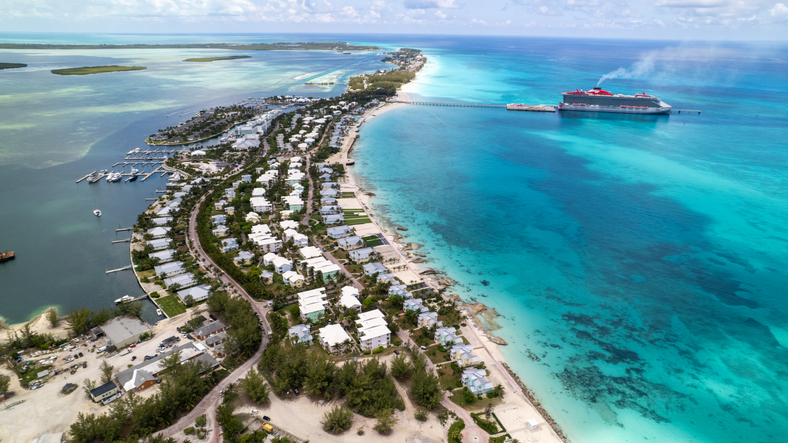
Several miles south of Nassau’s bustling, overly commercialized tourist trap of Paradise Island, Beverly Archer instructed me to follow her into her home.
“Don’t be shy, dear,” the 75-year-old said with a tone and accent as thick as the bowl of fish and grits she had just served me as she introduced me to her brother, nephew, and other family members. They were gathered around the kitchen island playing spades and filling the room with guffaws. I knew I was in the Bahamas, but I might as well have been at my Aunt Geneva’s house in Hazelhurst, Mississippi. This familiarity was gold that I wasn’t going to find at my accommodations at The Atlantis Resort.
Nassau is home to nearly 75% of the Commonwealth of the Bahamas’ population. It’s also the most visited of the nation’s over 700 islands, which stretch about 650 miles. Just last year, the capital city attracted more than 11.22 million international tourists. Historically, about 80% of travelers have been from the United States. And for Black Americans, the capital city is a popular destination for its safety and proximity to the U.S.
I have close friends and family who have visited the country, and I live in a Brooklyn community with neighbors who literally wear their Caribbean heritage on their sleeves. Yet when visiting Nassau in September, I was embarrassingly shocked by how much I knew about the country’s vacation spots and how little I knew about its history and culture, given the parallels to Black American history. I was introduced to much of this history as I sat in the state building during the 50th anniversary celebration of the People-to-People Ambassador Program.
The joyous sounds of the all-boys rake-n-scrape band from Eva Hilton Primary School carried the resilience of the enslaved Bahamians who used carpenters’ saws, pork barrels with goat skin, and other tools to play when British enslavers didn’t allow them musical instruments. The metal instrument may have been born of improvisation, but it carries a powerful sense of intentionality that continues to connect Bahamians to their African heritage.
Educator and storyteller Arlene Nash-Ferguson took the podium moments later to emphasize their ancestors’ “determination to survive.”
“There were other traditions that have come out with the determination to heal the soul from such a terrible experience,” she said. Enslaved Bahamians used the three-day Christmas holiday to recreate traditional West African festivals and “renew the spirit.” They would decorate themselves to symbolize their ancestors’ presence and use their bodies as a mark of defiance.
Like in the American South, enslaved Bahamians were prohibited from reading. Viewing paper as gold, they’d drape themselves in paper as an act of defiance, Nash-Ferguson said.
“And 200 years ago, in the night, at Christmas time, the Bahamians said, ‘We survived and celebrated life,’” she said. “It’s called the Junkanoo Festival, National Cultural Festival of the Bahamas. And we are very proud of it. It is about the strength and fortitude, and resistance of the people of the Bahamas.”
Dating back to the late eighteenth century, the parade has become a symbol of freedom unique to the island. The spirit and celebration of Junkanoo live on today as annual events on Boxing Day (the day after Christmas) and New Year’s Day. Government House guests got a preview of a Junkanoo rush-out as masked and costumed participants danced and played drums and rake-n-scrape.
As a Black American tourist, I often find myself conflicted traveling to predominantly Black countries, especially in the Caribbean. On one hand, these nations’ economies frequently rely heavily on tourism and are the most accessible and welcoming countries for Black people hoping to travel without racism staring them in the face at every turn. But I also must acknowledge the devastating impact of tourism in these countries, including water scarcity, cultural commodification, and labor exploitation. Traveling to the Caribbean with the intention of finding greater diasporic connection without contributing to this ecosystem of harm isn’t always a clear path when you aren’t traveling with someone who’s from there.
That made sitting in Archer’s home, bonding over both of us having strong women in our lineage named Amelia, and learning each other’s story, that much more special. Just like her mother, Amelia Archer, did at the founding of the People-to-People program, Archer has welcomed hundreds of visitors into her home, providing them with a more authentic and environmentally responsible experience. (The food is better, too.) As a host, her goal is to expand their view of the Bahamas and show them more of the history and culture than they would typically get by limiting themselves to paradise islands and curated excursions.
Archer resents the increasingly Americanized tourist spots, noting that they take away from more local and authentic shops and restaurants.
“I love my country, and I love my heritage,” Archer said. “We have our own heritage, people come here for that, and we have to show that.”
Anthia Butler, a third-generation ambassador for the program, also grew up helping her mother prepare their home to host a “jitney load of guests.” In a phone interview, she emphasized her people’s hospitable ways.
“Bahamians don’t just like to meet people, y’know. We adopt them,” Butler said. “You may come as a visitor, but believe you me, by the time you leave, you would’ve at least encountered or obtained one Bahamian auntie, a cousin, or someone trying to sneak you a recipe.”
No nation is without its flaws, but stepping into a country that celebrates its own Black history while embracing Black Americans is refreshing. In the U.S., there’s been a multigenerational effort to revise and erase our history — and recently the Trump administration has hit the gas pedal. That energy has led to contentious diaspora wars and, as bell hooks noted in “Rock My Soul,” an identity crisis that has impacted Black Americans’ self-esteem. And it’s created the foundation for harmful myths, including that Black Americans have no culture.
But understanding Black culture and history globally plays a part in shifting that narrative, especially when examining those whose ancestors’ bloodshed during the Trans-Atlantic Slave Trade. The tenacity and soul of rake-n-scrape is akin to ring shout, hambone, and the blues. Bahamian dialect is to British English as Ebonics is to American English. And the love the island’s natives put into making conch salad and Johnnycakes feels as full as Black Americans’ gumbo and cornbread.
Even more directly, Bahamian culture feels distinctly linked to Gullah Geechee culture found along the Carolina coast. The Gullah Geechee people were able to uniquely hold onto the folkways, language, and traditions of their African ancestors, in nearly identical ways to those of Bahamians. In fact, the Gullah Geechee people who were sent to Nassau during the Revolutionary War brought their customs with them.
Throughout history, our music, food, and dialect have been the most accessible forms of expression we’ve been able to hold onto. It’s the pulse that not only connects our individual cultures to our ancestors, but also to each other.
In June Jordan’s “Report From The Bahamas, 1982,” she interrogates the classism and racism that come with the privileged tourism she, too, participates in. She also questions diasporic unity on the basis of having a shared history of oppression: “I am saying that the ultimate connection cannot be the enemy. The ultimate connection must be the need that we find between us. It is not only who you are, in other words, but what we can do for each other that will determine the connection.”
Travel is great for shifting perspective, but that shift can be temporary or shallow, as we return to our preconceived notions as our planes take off and carry us home. As a Black woman traveling to countries where the majority looks like me and shares a similar cultural fabric, I recognize that there is more of a responsibility that I’m called to take on. I find it hard to differentiate my own struggles from those of my Caribbean siblings.
Upon returning to the U.S. from Nassau, ICE detained Ian Roberts, a Guyanese superintendent who has done impactful work in diverse school districts across the country. The following week, they raided a Chicago apartment complex and arrested dozens, including at least a half-dozen Americans. ProPublica found that at least 170 U.S. citizens have been detained by ICE just this year, with more than 20 being held for more than a day without being able to contact their families.
As Jordan said, it is not enough to bond over shared oppression. There has to be more. And there is more. Understanding the commonalities of our traditions, cultures, and beliefs helps us not only to have greater compassion across the diaspora, but also to foster a necessary community amongst one another. That goes for both at home and abroad.
For Archer, Butler, and other Bahamians who’ve opened their homes to others, this is a first step toward greater connectivity and appreciation.
“As human beings, we are supposed to be sympathetic, empathetic, understanding, and I think the basic human right to be accepted for who you are, regardless of race, creed,” Butler said. “Being able to host and welcome people and to make them feel accepted, to make them feel seen, to make them feel free, to be expressive just based on who they are, that’s really important.”
SEE ALSO:
Solo Travel, Black Girl Joy, And Tracee Ellis Ross
Why Martha’s Vineyard In August Should Be On Your Travel List


