Of Course Trump Undermined Civil Rights Ahead Of MLK Day
Of Course Trump Undermined The Civil Rights Act Ahead Of MLK Day
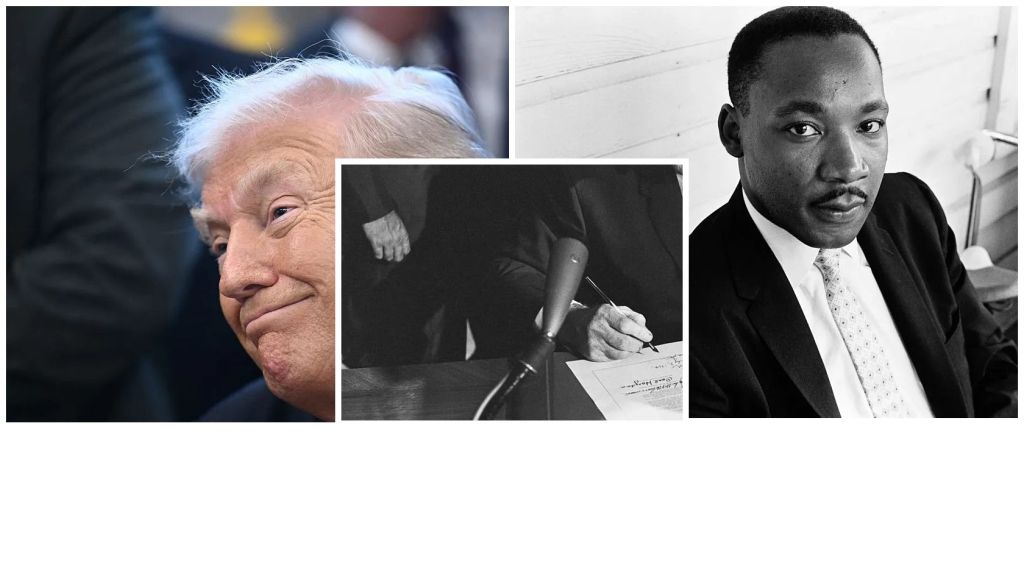
When a president attacks a movement that was led by a global icon days before his life is celebrated, it’s by design. Because while Donald Trump might not be able to walk in a straight line anymore, he hasn’t forgotten how to keep Black America in his crosshairs.
A week before the national holiday honoring Dr. Martin Luther King Jr., the president of the United States made sure to find time to insult a crusade that improved the very country he governs, partly due to it being led by a Black man who won an award he’ll never be considered for.
“White people were very badly treated, where they did extremely well, and they were not invited to go into a university or college,” he said to the New York Times, while attempting to sully the Civil Rights Movement by suggesting it was a vehicle of “reverse racism.”
“So I would say in that way, I think it was unfair in certain cases.”
Clarence Thomas and Ben Carson have to be somewhere soaking their feet due to the injuries that occur from dancing with the devil, as their successes are byproducts of the very movements and systems that they and the president currently stand against. Thomas’ silence had long been bought. Carson has been a lost cause for a while now. And despite being two of Trump’s favorite Black allies, in the past, when both men were proponents of justice, they were open about how civil rights and affirmative action played huge roles in their stories.
“God only knows where I would be today,” Thomas once said in a speech about affirmative action, as it stands as the reason he was admitted to Yale Law School. “I certainly believe that I benefited from affirmative action,” Carson wrote in a 2014 Op-Ed, as he went on to say that the system, “was based on the admirable concept that we should take into consideration inherent difficulties faced by minorities growing up in a racist society.”
In a single statement, Trump diminished the foundation of both of their legacies. He did them worse than when Snoop kicked over Jody’s son’s fort in Baby Boy.
“I think it was also, at the same time, it accomplished some very wonderful things, but it also hurt a lot of people — people that deserve to go to a college or deserve to get a job were unable to get a job,” Trump added. “So it was, it was a reverse discrimination.”
What Trump and so many of his supporters and conservatives refuse to accept is that Black people can’t be racist, nor can “reverse discrimination” exist in America. Black people can be prejudiced and bigots, but given that white supremacy has placed Caucasians as the race in power, it has always denied Black Americans the opportunity to systemically exclude and exterminate our white counterparts. The minority can’t treat the majority the same way that the majority treats the minority, while still being in the minority.
For decades, racists have been convinced that Black people and minorities were “replacing” them. But to that I ask, how can you take college admission spots and employment opportunities from people who weren’t good enough to gain entrance or do the job to begin with? And even if they were, were they going to be the most talented individuals in those classrooms and office spaces, or just more perpetrators of the mediocre results that far too often keep certain universities and companies alive, as they thrive behind a veil of make-believe excellence? Look at what happened when one of them was put in charge of DOGE, and the current occupant of the Oval Office is a twice-impeached convicted felon.
“I have been at probably every powerful table that you can think of, I have worked at nonprofits, I have been at foundations, I have worked in corporations, served on corporate boards, I have been at G-summits, I have sat in at the U.N.: They are not that smart.” — Michelle Obama.
Almost seven years ago, those who often feel supplanted and overlooked because of diversity were exposed when the college admissions scandal rocked the higher education world. Actresses Felicity Huffman and Lori Loughlin were among a group of at least 50 people who were charged for trying to bribe and cheat to get their underperforming kids into elite colleges. It was a reminder that fame, fortune, and wealth do not equate to intelligence.
“More than 80% of college admissions officers are white, and it’s even whiter at the director level,” Shaun Harper explained to me at the time. Harper is the founder of the Race and Equity Center at the University of Southern California, a campus at the center of the scandal. “Although we haven’t seen a comprehensive list of all the families involved in this scam, I’ll go out on a limb and guess that the overwhelming majority of those people are white, given the way that wealth is disproportionately distributed. It shows the sense of white entitlement to elite universities.”
Over time, as the Civil Rights Movement evolved to things like affirmative action and diversity, equity, and inclusion (DEI), history has reminded us that it has been white women who benefited the most from both systems — not Black people. The information is relevant given that it demonstrates how Trump hates something that helped the group of women who put him in office twice, as they chose their oppressor over their gender and the foundation of their successes in 2016, 2020, and 2024.
Around this time last year, the Trump administration was preoccupied with ending DEI initiatives, even as the White House held a Black History Month reception. At the ceremony, Trump announced his plan for a National Garden of American Heroes, in which he said that historic Black Americans, including Coretta Scott King and Martin Luther King Jr., would be featured.
Funny enough, the Black people in that room wouldn’t have been able to vote and/or support him if not for the Civil Rights and Voting Rights Act of the 1960s. The situation perfectly illustrates where we stand today and how the president operates — especially given that construction on the Garden of Heroes has yet to begin.
Carron J. Phillips is an award-winning journalist who writes on race, culture, social issues, politics, and sports. He hails from Saginaw, Michigan, and is a graduate of Morehouse College and Syracuse University. Follow his Substack to keep up with more of his work.
SEE ALSO:
Trump Supports Hanging White Politicians, And Likely Black Ones Too
The Burdens And Responsibilities Of Being The 1st Black (Fill In The Blank)


