The Sacred Resistance Of Black Women Political Prisoners
Black August And The Sacred Resistance Of Black Women Political Prisoners
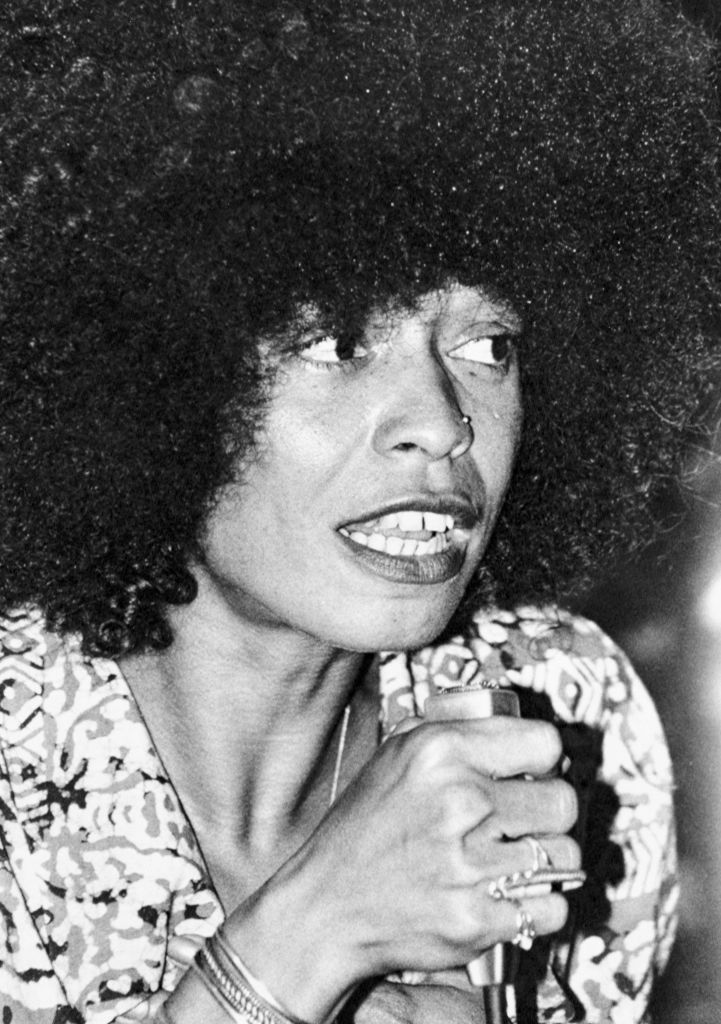
Every year when Black August rolls around, the stories we pull from the archive tend to center on Black men’s experience while the distinct warfare waged against Black women political prisoners gets reduced to a quiet whisper, if mentioned at all.
I learned to tune my ears to those whispers early on in my academic career. My education in Black political activism began on the streets of North and West Philadelphia, not far from my university’s lecture halls.
It was nearly impossible to remain oblivious to Black political struggle while living in Philadelphia, a city mired in a brutal history of police terror aimed narrowly at the Black community. Under the reign of former Philadelphia police commissioner Frank Rizzo, Black neighborhoods were targeted and regularly brutalized by his police force.
The first Black political prisoner in Philly I learned about was Mumia Abu-Jamal, the incarcerated journalist convicted of murdering a Philadelphia police officer whose dispatches from the bowels of Pennsylvania’s carceral system exposed the state’s incessant war against Black liberation in general and Black prisoners in particular. His name was written into the very fabric of the city, with “Free Mumia” posters lining storefront walls and plastered on trees.
At the same time, I was introduced to lesser-known Black women political prisoners through Ramona Africa’s activism. Africa was a member of the MOVE family, a radical, back-to-nature group that lived communally and fiercely resisted technology and state intervention. Africa was a regular fixture on campus, organizing and protesting to bring recognition to her comrades who had been locked away since the August 1978 police siege of the group’s Powelton Village home.
Following a shootout during that military-style raid, a single bullet killed a police officer. Even though the MOVE members claimed the officer was killed by friendly fire and ballistics could not trace the shot to a specific weapon, the state found nine members of the commune guilty of third-degree murder.
Much of the coverage was focused on the five men who were locked away, and very little media attention was given to the four women who were found guilty and imprisoned. One of the women, Debbie Africa, gave birth to a son while in prison.
Two of the other women, Janine and Janet Africa, would go on to spend more than four decades in prison before their 2019 release on parole.
Janine’s losses stretched across those decades on both sides of her sentence. Two years before the 1978 raid, during a scuffle between the police and MOVE, Janine was knocked over while holding her baby, Life. The infant died shortly after.
While she was behind bars, Janine tragically lost another son, twelve-year-old Lil Phil, in 1985 when Philadelphia police dropped a bomb on the collective’s new communal home, situated just three miles away from my college dorm.
As evidenced by Janine’s experiences of having lost two children at the hands of the state, Black women political prisoners face distinct layers of reproductive and psychological injustices.
The targeted warfare on Black women is a terrifying pattern that repeats across American carceral history. To be a Black woman revolutionary meant risking your own freedom while simultaneously having to protect your children from the state.
We see this in the story of the late hip-hop star Tupac Shakur’s mother, Afeni. Afeni Shakur was a brilliant strategist and member of the New York Black Panther Party, arrested in 1969 as part of the Panther 21 conspiracy case.
Facing a seemingly insurmountable 300 years in prison, Afeni spent much of her pretrial detention inside the oppressive walls of the Women’s House of Detention in Greenwich Village while pregnant with Tupac. The carceral conditions inside the facility were notoriously inhumane, defined by spoiled food and a lack of basic necessities like toilet paper. Afeni and her co-defendant Joan Bird reported prison doctors who seemed keen on subjecting women to invasive, non-consensual examinations.
While behind bars awaiting trial, she faced severe malnutrition and obtained a court order that allowed her one glass of milk and a hard-boiled egg a day. While she successfully defeated the state’s charges against her, Shakur’s story is a reminder of the added psychological and physical torture designed specifically to break the resolve of pregnant Black women revolutionaries, who also faced pressure from men within the movement to procreate and produce the next generation of revolutionaries and freedom fighters.
While Afeni Shakur gave birth to Tupac one month after being released from prison, Black women political prisoners like Debbie Africa, who gave birth to her son Mike Africa behind bars, often did so under surveillance and duress that rarely made it into the record, a detail advocates and historians alike say gets lost because the official story of Black political imprisonment centered Black men and their experiences with incarceration.
The male-centered focus similarly obscures the deep relationships some of these women formed, such as the rumored romantic relationship Afeni is believed to have built with fellow political activist Carol Crooks. The two women were incarcerated together, and after Tupac was born, Shakur briefly gave him the last name Crooks.
Years later, in August of 1974, just three years after the infamous, male-led Attica prison uprising, Crooks sparked a rebellion of her own from inside a women’s prison in Bedford Hills, New York.
The rebellion at Bedford Hills began after Crooks successfully challenged the facility’s practice of throwing women into solitary confinement without advance notice of the charges against them. Guards retaliated by beating her and locking her back in solitary. More than 200 women rose up in response, taking over sections of the prison and holding guards hostage. The August Rebellion still stands as one of the biggest women’s prison uprisings in U.S. history and effectively forced New York to guarantee due process rights for incarcerated people, a protection that holds today.
Crooks won her fight from inside prison. One of our more well-known Black political revolutionaries, Assata Shakur, broke free from prison walls, only to trade one confinement for another, exiled for the rest of her life from the country that bore her and never stopped hunting her.
As the one-year anniversary of Shakur’s death approaches, I have found myself reflecting deeply on the four and a half decades she spent in exile. Convicted of murdering a police officer and freed by Black Liberation Army members who visited her in prison and helped her escape, she resurfaced five years later in Havana, Cuba.
Staying free for Assata meant remaining in hiding there and staying careful, watching who she trusted, and how she moved around the country. She was never fully able to let her guard down in a country that granted her asylum but couldn’t erase the reach of a government still hunting her.
It’s hard not to imagine what Shakur might have offered us had she made her way back to America as a free woman. A public return for Assata Shakur would have been a monumental victory for global Black liberation movements and served as a living testament to survival.
Perhaps we can still hold out hope that a posthumous literary offering surfaces the same way we still get surprise archival music drops from our musical icons who have gone on to glory.
In the meantime, we have Black women activists like Angela Davis to learn from. Angela Davis spent more than a year in prison after being charged with kidnapping, murder, and criminal conspiracy for a courthouse shootout she wasn’t present for that killed a judge and three others. While she was ultimately acquitted of all charges, her experiences in prison led her to a lifetime of work on prison abolition and advocacy for political prisoners.
Women like Angela Davis were the backbone of these Black liberation movements. In fact, women made up more than 60 percent of the Black Panther Party at its height. More of our remembrances of Black August need to recall that when the state targeted Black women, their imprisonment placed them among the most vulnerable people inside, subjected to severe reproductive injustice, forced family separations, and intense medical exploitation designed to break their spirits and resolve.
In a letter to Davis during her imprisonment, writer James Baldwin articulated the collective stakes of this reality, saying that “we must fight for your life as if it were our own.” That solidarity fueled Davis’ long-held belief that all of our stories and lives are inextricably bound together, a reminder that the perimeter of our shared freedom is only as safe as the most vulnerable among us.
Or, as both Baldwin and Davis once warned about when it comes to the vulnerability of Black women freedom fighters, if they come for me in the morning, they will come for you by night.
SEE ALSO:
Monifa Bandele Explains The Critical Importance Of Black August
Black August Lesson: ‘Denim Is Interwoven With Stories Of Struggle And Resistance’


